
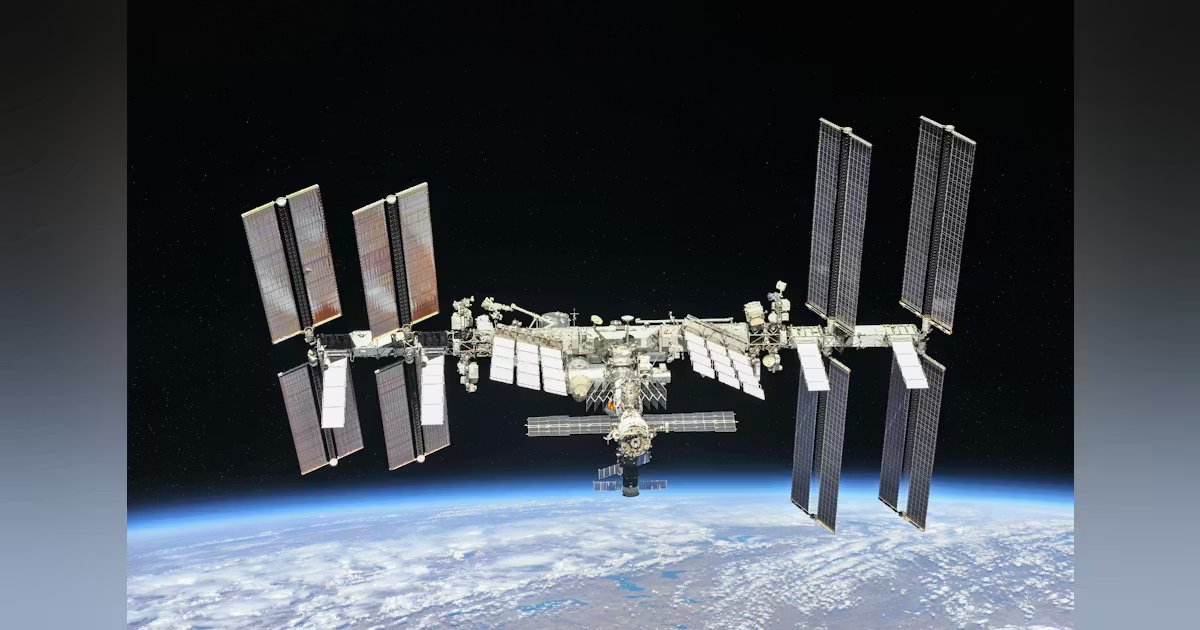
When NLM Photonics’ silicon-organic hybrid (SOH) photonic chips arrived at the International Space Station (ISS) aboard JAXA’s HTV-XI spacecraft on October 29, 2025, it marked a convergence of two critical technology frontiers: An urgent need for power-efficient, high-bandwidth optical communications and sensing for space applications, and the maturation of hybrid organic electro-optic (OEO) technology as a viable solution for next-generation photonic systems.
Space presents the ultimate proving ground for electronics and photonics. Unlike terrestrial environments where we can control temperature, shield against radiation, and maintain atmospheric pressure, spacecraft systems must operate reliably in conditions that push technology to its absolute limits. Temperature swings of -65° to 125°C, continuous cosmic radiation, atomic oxygen erosion, and the vacuum of space create a perfect storm of environmental stressors that can degrade or destroy conventional photonic components.
Optical communications systems are increasingly critical for sensing and high-bandwidth data transmission from satellites, deep space missions, and future lunar bases. But the environmental challenges that space creates directly impact mission success. Traditional silicon photonic modulators face fundamental limitations in modulation efficiency and bandwidth, which requires higher operating voltages and use of amplifiers that challenge spacecraft power budgets.
Break the silicon ceiling with organic materials
NLM’s approach leverages the exceptional Pockels coefficient of organic electro-optic materials, with 10x better modulation efficiency than conventional silicon junction-based modulators to enable up to 50% reductions in size and power. Such efficiency is critical for size, weight, and power (SWaP) constraints in applications where every watt and every gram matter.
The silicon-organic hybrid (SOH) architecture we’ve developed integrates our OEO materials, including our proprietary Selerion-HTX, into silicon photonic waveguides through a back-end-of-line process. This approach maintains compatibility with standard silicon photonics foundry processes and delivers modulation efficiencies that rival or exceed expensive alternatives like thin-film lithium niobate (TFLN) or indium phosphide (InP).
Beyond SWaP and performance advantages, this scalability is low cost for the space services industry, particularly for large satellite constellations and other expendable applications.
The MISSE-21 mission: Real-world validation
The Materials International Space Station Experiment (MISSE-21) provides an unparalleled opportunity to validate our technology within actual space conditions. During six months, our chips will be exposed to the full spectrum of space environmental factors on the ISS’s external platform.
This mission includes multiple chip configurations to test different aspects of our technology: SOH modulators, developed in collaboration with AIM Photonics through a NASA STTR Phase I contract led by Scott Hammond at NLM, feature Selerion-HTX, our commercial-grade material optimized for thermal stability exceeding 120°C, and our workhorse JRD1 research-grade material, often used by our academic partners. Plasmonic modulators developed by our partner Polariton Technologies demonstrate the versatility of our Selerion-HTX materials across different photonic architectures.
Comprehensive testing aboard the ISS will provide critical data about radiation tolerance, thermal cycling effects, and long-term stability under atomic oxygen exposure.