Laser Technology

Laser Technology

Dual-sided laser processing can tap static beam shaping and splitting

Figure 1c shows a configuration for wafer-level applications scalable to different sizes by selecting appropriate F-theta focal lengths. For example, a 300-mm focal length system provides coverage for 200- to 300-mm wafers with spot sizes of 10 to 50 μm for scribing. Double-sided scribing. Silicon wafers for power semiconductors and solar cells require scribe lines […]

Dual-sided laser processing can tap static beam shaping and splitting Read More »

Podcast Chat: Aerotech: Displaying the Future of Innovation

This edition of Following the Photons features Brian O’Connor, vice president of Growth and Strategy at Aerotech, a globally reaching developer of advanced precision motion control and automation technologies for industries including optics and photonics, precision manufacturing, and life sciences. He recently sat down with our host Justine Murphy at the SPIE Photonics West exhibition

Podcast Chat: Aerotech: Displaying the Future of Innovation Read More »

Ultrafast light switch for optical data components

By pairing a nanostructure of silver with an atomically thin semiconductor layer, a team of researchers from Italy, the U.K., and Germany, led by Christoph Lienau, a physics professor at the University of Oldenburg, created an ultrafast switching mirror device that can serve as an optical transistor—and it clocks in at a speed 10,000x faster

Ultrafast light switch for optical data components Read More »

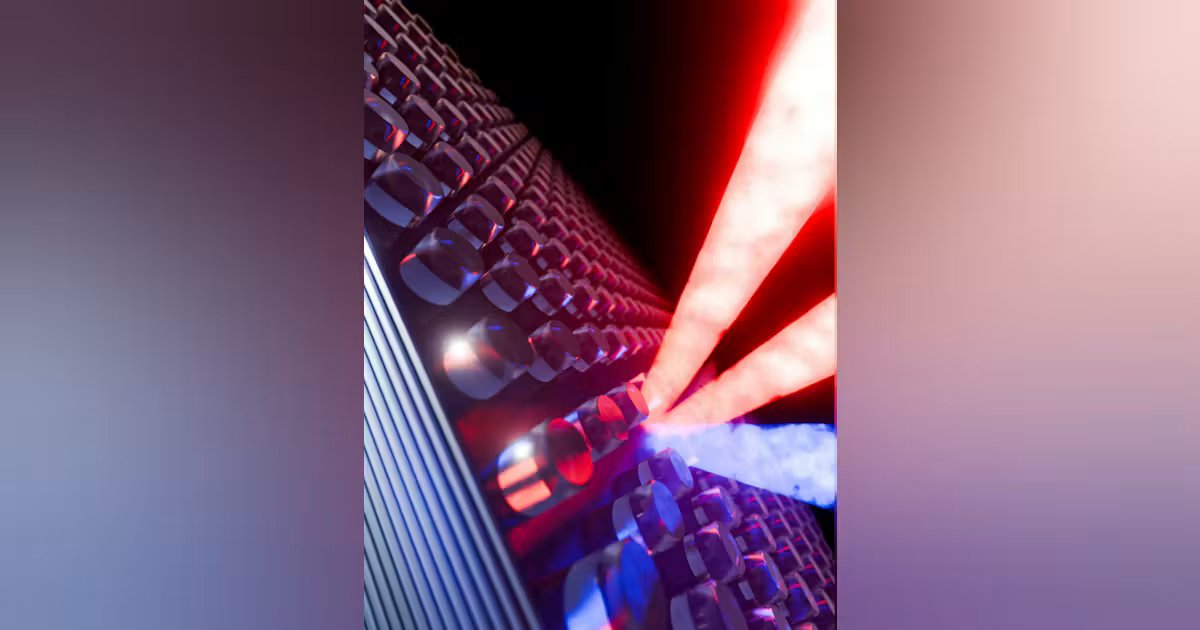
Nonlinear metasurfaces convert infrared light to visible

The injected pump field-generates third-harmonic radiation within the visible (close to 500 nm) inside the silicon, which inherits the pump’s phase gradient. This gives rise to nonlinear polarization currents that scatter the third harmonic to the far field in a direction dictated by the engineered phase gradient. Because the phase gradient of the third-harmonic field

Nonlinear metasurfaces convert infrared light to visible Read More »

Near-range LiDAR may monitor, warn Arctic ships about dangerous icing

The Marine Icing model for the Norwegian Coast Guard (NoCG; MINCOG) formulated in 2016 by Eirik Samuelsen of the Norwegian Meteorology Institute includes more metocean data, plus selected ship and course details based on the accretion rates observed onboard three Norwegian Coast Guard vessels of the class NoCG “Nordkapp” navigating within the Barents Sea during the

Near-range LiDAR may monitor, warn Arctic ships about dangerous icing Read More »

Shopping Cart
Scroll to Top