
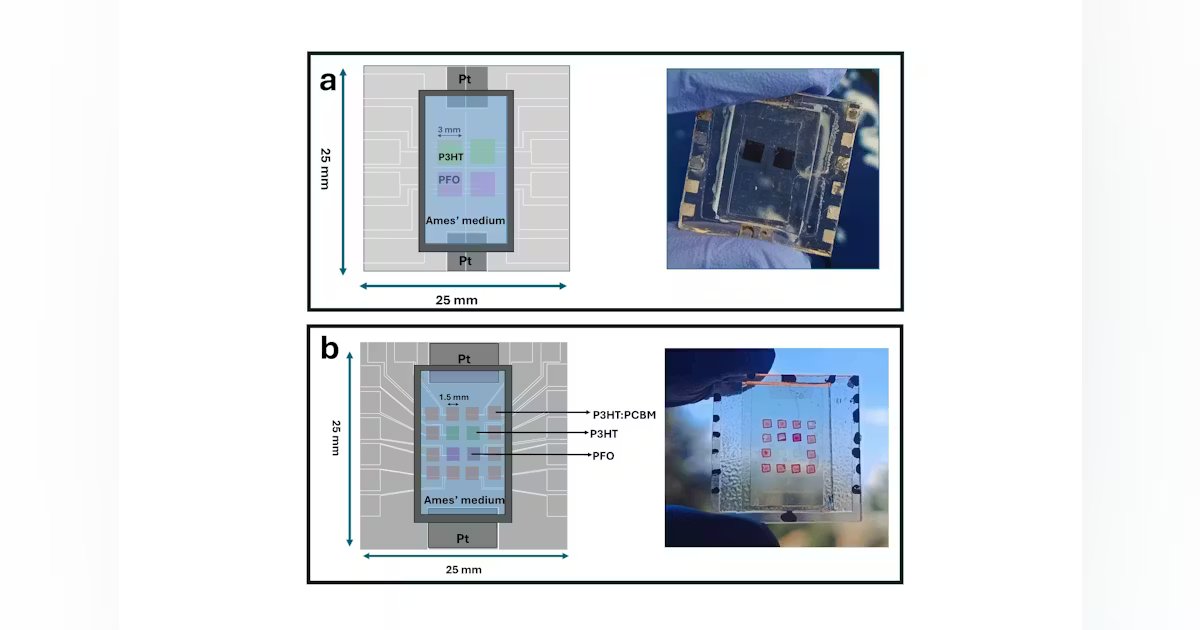
A retina-inspired biohybrid image sensor array (BIOPIX) created by a team of researchers led by Thomas M. Brown, a professor of organic and biological electronic engineering at Tor Vergata University of Rome in Italy, responds to light in a way remarkably similar to the photoreceptor cells of a retina—in terms of speed and how it senses color.
The team’s “retina emulator” combines organic electronics with biological liquids to convert light into electrical signals in a manner akin to a retina’s rods and cones, and generates real-time images on a display (which is believed to be the first demonstration of its kind).
“Years ago at a Materials Research Society meeting, I was deeply impressed on several levels—scientifically and in terms of innovation and the potential to improve the quality of life—by a demonstration of a man who was blind for many years receiving a silicon/metal retinal implant,” says Brown. “Afterward, he was able to identify and pick up a white cup placed against a black background. It was a profound moment for me.”
At the time, Brown was researching organic semiconductors for photovoltaics, which other researchers had shown worked for the same applications and offered flexibility and biocompatibility. It led to a collaboration with Ebin Joseph, a postdoctoral researcher, as well as Antonella Camaioni, a professor of histology in the school of medicine at Tor Vergata University of Rome, an interdisciplinary team of 15, and funding agencies interested in creating a retina emulator.
How do you build a retina emulator?
The team’s array design combines 12 pixels to mimic rod-like responses (night vision) with a central 2 × 2 array (think matrices) to simulate cone-like dichromic sensitivity (color vision in most mammals).
To get started, the researchers print different semiconducting conjugated polymers over transparent laser-patterned microelectrodes that absorb light with similar spectral shapes to the cone and rod photoreceptor cells in mice.
“On the same platform, we integrated a reference electrode with a platinum nanoparticle surface that can exchange charges with ions, and created a small chamber that we filled with a water-based physiological medium resembling the physiological conditions found within live retinal tissues,” explains Brown. “This electrolytic medium, by immersion, connects all of these components together electrically, which enables the device array to become optoelectronically active.”
Each polymer responds preferentially to a specific spectral region. “In our device architecture, P3HT (a p-type semiconducting polymer) shows sensitivity to green light (similar to the medium wavelength M-cone of a mouse); PFO (a wide-bandgap blue-light-emitting polymer) responds primarily to ultraviolet wavelengths (similar to the short wavelength S-cone of a mouse); and P3HT:PCBM has a similar absorption profile to P3HT but shifted toward the blue (more similar to the rod cells of a mouse),” Brown adds.
Biocompatibility of the technology platform and its materials was confirmed through in vitro testing of culturing primary human mesenchymal stromal cells over its surface. “Its good biocompatibility highlights the potential for using the electrode and semiconducting materials we used here in future biomedical applications,” says Brown.
Once light is absorbed by the polymer pixels of the array, an electrical signal is created that’s conducted through the water-based physiological medium to the reference electrodes. “The electrical signals coming out of our array resemble in shape, as well as characteristic times, those found within mouse photoreceptor cells,” Brown points out. “And the electrical signals generated by each pixel are then processed through a dedicated electronic readout system, which allows us to create pixelated images in real time—demonstrating color sensitivity (through the artificial cone pixels) and grayscale contrast (through the artificial rod pixels). We believe this is the first demonstration of imaging on a display in real time through a liquid/solid biohybrid sensor array.”