
Modern precision optical instruments are increasingly limited not by light sources, electronics, or vibration isolation but by the microscopic thermal motion of mirror coatings that form the reflecting surfaces of optical cavities. In optical atomic clocks, ultrastable lasers, stabilized frequency combs, and gravitational-wave detectors, this inherent thermomechanical noise from multilayer mirror coatings sets a noise floor, and a consequent limit on the capability of such instruments.
The thermal motion of the mirror surface is an example of Brownian motion, discovered two centuries ago by botanist Robert Brown who famously noticed pollen jittering around when suspended within liquid (it took almost a century before Einstein explained that the motion was due to thermal energy). Reducing this vexing “Brownian noise” requires the development of mirror coatings with low elastic losses while simultaneously retaining excellent optical properties. Although current state-of-the-art sputtered coatings have excellent optical properties, they suffer from high elastic losses, which leads to high Brownian noise.
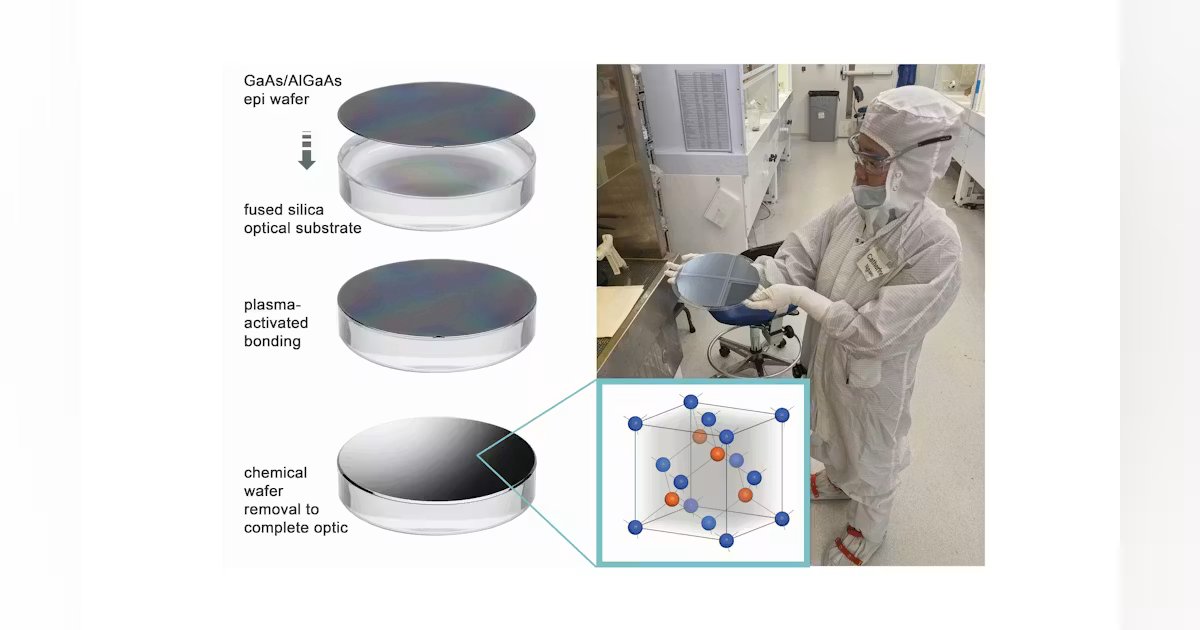
In contrast, crystalline coatings exhibit exceptionally low Brownian noise and simultaneously excellent optical properties. For this reason, cavity-stabilized lasers deployed in the highest-precision optical atomic clocks now use crystalline supermirrors. These unique high-reflectivity coatings are made from dozens of epitaxially grown semiconductor layers, typically alternating high-refractive-index gallium arsenide (GaAs) and a ternary alloy of aluminum gallium arsenide (Alx Ga1-x As) for the low index layers.
Mirrors in current gravitational wave detectors are made of ion-beam-sputtered (IBS) amorphous oxide, multilayer stacks. The low refractive index layers in the stack are typically made of silica, which has low elastic loss; it’s the high-index layers that are the noise culprits because of their rather high elastic loss. High-index layers are typically metal oxide alloys—such as TiO2:Ta2O5, TiO2:GeO2, or TiO2:SiO2—that have elastic loss (ratio of imaginary to real part of elastic constant) around 10-4. These materials exhibit excellent optical performance, but the elastic losses are high enough to limit the detector sensitivity and subsequently the rate of detections.
Brownian noise: The challenge remains
Decades of materials development have reduced the problem but not eliminated it. In fact, during the last observation run, LIGO detectors were limited by coating Brownian noise in their most sensitive and astrophysically important frequency band between a few tens and a few hundreds of Hertz. In contrast, AlGaAs coatings have thermal noise corresponding to elastic loss with an upper limit of about 10-5. This makes crystalline supermirrors an excellent candidate for use in gravitational wave detectors. With concurrent reductions in detector quantum noise, crystalline coatings promise a 5× improvement in the performance of gravitational wave detectors in the highest sensitivity detection band.
The challenge of adapting crystalline supermirrors for gravitational wave detection is primarily scaling them to the required size. Tabletop, ultrastable cavities used in optical clocks typically use centimeter-scale (25.4-mm diameter) mirrors. Such 1-inch crystalline mirrors are now produced commercially and can be purchased off the shelf from Thorlabs. By comparison, Advanced LIGO’s arm-cavity mirrors—the test-masses that respond to gravitational-wave-induced fluctuations of spacetime—are 34 cm in diameter and future detectors will require larger mirrors. Scaling up the centimeter-scale coatings with excellent optical properties to the size needed for gravitational wave detectors is the challenge now being addressed.
Beyond Brownian noise from the mirror coatings, gravitational-wave detectors are limited by quantum noise. Quantum noise is a combination of low-frequency mirror motion due to buffeting by photons and high-frequency Poisson noise—the “hiss of photon rain”—on the detection photodiodes. It can be reduced by using squeezed light, but the squeezing is diluted by optical losses in the detector arm cavities. This sets stringent limits on the optical absorption and density of defects. Therefore, maintaining or improving optical properties of the coatings must go hand in hand with reducing Brownian noise.
Larger detectors, crystalline supermirrors, or both?
Due to the intransigence of coating Brownian noise, and the challenges in significantly reducing quantum noise, the gravitational-wave community is pursuing two complementary strategies. One is to make the detectors much larger. Cosmic Explorer, for example, is planned to use 40-km-long arms, 10× the length of LIGO. A possible second detector with 20-km-long arms could be built if the global network of gravitational wave detectors is too weak to provide good signal-source localization. Longer arms increase the gravitational-wave signal and make the detector less sensitive to fundamental noise sources, including Brownian noise. But longer arms do not make coating noise irrelevant. Coating thermal noise still affects design choices, particularly mirror size, beam size, operating wavelength, optical absorption, etc.
The second strategy is to solve the coating problem directly. Crystalline supermirrors made from substrate-transferred GaAs/AlGaAs coatings are the leading candidate today because they have already demonstrated much lower coating thermal noise than conventional dielectric multilayers while retaining comparably low optical absorption. In a first demonstration of this novel mirror technology in 2013, Garrett Cole and collaborators reported a tenfold decrease in elastic loss and consequent reduction in Brownian noise. This result made crystalline coatings a serious candidate for any instrument requiring ultrastable optical cavities, including gravitational-wave detectors and optical atomic clocks.
Building off this initial demonstration, national metrology laboratories worldwide have incorporated crystalline mirror technology into state-of-the-art optical-clock systems. Record performance has now been realized at JILA in Boulder, Colorado and PTB in Braunschweig, Germany, where researchers are using crystalline mirrors integrated with cryogenic silicon cavities for the lowest-noise cavity-stabilized laser systems. These experiments benefit from the improved Brownian noise performance of crystalline coatings, but they also reveal additional complexity. In contrast to amorphous oxides, certain crystalline materials are by nature anisotropic. After installing crystalline mirrors, the JILA and PTB groups noticed a new and unexpected source of noise—phase fluctuations that were anticorrelated between orthogonal polarizations of light. This is not coating Brownian noise and appears to be driven by the incident light itself. But the anticorrelated nature of the new noise is fortunate, because it allows this effect to be minimized by averaging two equal-intensity polarization modes. This way, they still realize the Brownian noise advantage of the crystalline coatings.