
Optical frequency combs (OFCs) are precise laser light sources whose spectra consist of a series of equally-spaced frequency lines that resemble the teeth of a comb. As highly accurate rulers for measuring optical frequencies, OFCs have revolutionized precision measurement and metrology since their development in the late 1990s. One of the most important capabilities enabled by OFCs is spectral purity transfer. It refers to the ability of an OFC to transfer the spectral purity—frequency stability and narrow linewidth—of one light source to another operating at a different wavelength.
In an ultralow-noise implementation (patented by Menlo Systems1), spectral purity transfer preserves the characteristics of ultrastable optical reference systems across the entire comb spectrum, including frequency-converted outputs spanning the visible to the mid-infrared spectral regions.
Intro to optical frequency combs
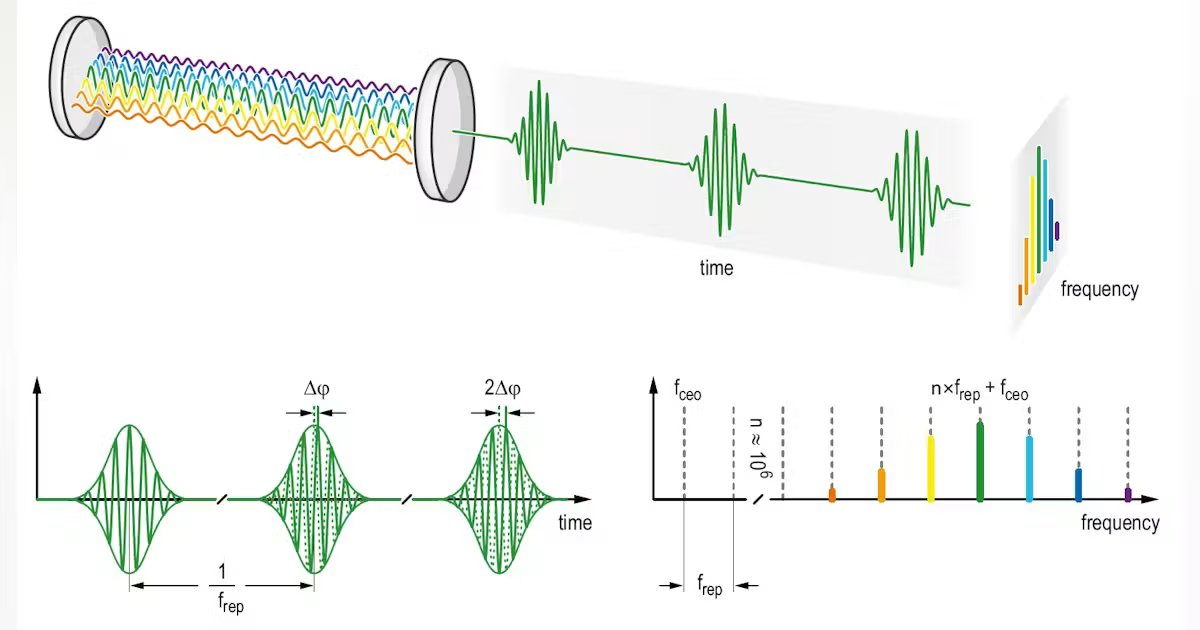
An OFC is a laser source whose optical spectrum consists of a series of discrete, equally-spaced frequency lines. In the frequency domain, this regular structure resembles the teeth of a comb. OFCs are most commonly generated using ultrashort, modelocked lasers (see Fig. 1, top). Modelocking is a technique in which the longitudinal modes of a laser cavity are forced to oscillate with a fixed phase relationship. Consequently, the laser emits a series of ultrashort optical pulses. The circulating pulse propagates back and forth inside the laser resonator at a repetition rate frep, which is determined by the cavity round-trip time. During each round trip, a small amount of pulse energy is extracted via a partially transmissive mirror to form the laser output. In the time domain, this output appears as a regular pulse train and in the frequency domain, it corresponds to a comb of equidistant spectral lines (see Fig. 1, bottom).
Due to dispersion in the laser cavity, the group velocity of the pulse envelope usually differs from the phase velocity of the optical carrier. This mismatch results in a gradual phase shift Δφ of the carrier wave with respect to the pulse envelope from one round trip to the next. This phenomenon is referred to as carrier-envelope phase offset (see Fig. 1, lower left).
Ideally, in the absence of noise and external perturbations, the Fourier relationship between the time and frequency domains implies that a strictly periodic pulse train corresponds to a discrete set of equally spaced frequency modes (see Fig. 1, lower right).
In the frequency domain, the individual comb lines νn are given by:
vn = nfrep + fceo,
where n is an integer mode index, frep is the pulse repetition rate, and fceo denotes the carrier-envelope offset frequency. The entire comb spectrum is shifted by fceo as a result of the pulse-to-pulse carrier-envelope phase slip, while the spacing between adjacent lines is solely determined by frep. In practice, both the repetition rate frep and the carrier-envelope offset frequency fceo must both be measured and actively stabilized for an ultrafast pulsed laser to function as an OFC. The measurement of frep is comparatively straightforward, because it typically lies within the range of tens of megahertz to a few gigahertz and can be detected using a fast photodiode. Repetition rate stabilization is achieved by closing a feedback loop on actuators that allow for effective cavity length adjustments. In contrast, measuring and controlling fceo is significantly more complex and represented a major challenge in the early development of OFC technology.
Difference-frequency generation (DFG) frequency combs
Historically, one of the early strategies for dealing with the carrier-envelope offset frequency was an optical scheme that avoids the need for its explicit measurement and control altogether. This is achieved using the inherently carrier envelope phase stable nonlinear process of DFG to create a replica of the original laser pulse train, which results in an average fceo value of zero (<fceo> = 0). In such DFG-based OFCs, two distinct spectral components originating from the same laser oscillator (typically after spectral broadening in nonlinear fibers) are mixed in a nonlinear crystal. In an ideal case both components will carry the same fceo, so subtracting their frequencies will cancel out the offset to produce an “offset-free OFC.” From a purely technical standpoint, offset-free OFCs offer simplicity by requiring only one control loop: Their only control variable is the repetition rate frep. But this comes with a tradeoff: An expectation value <fceo> = 0 does not imply the overall absence of fceo phase noise. In other words, while the DFG process removes the average offset it does not suppress incoherent noise associated with fceo (see Fig. 2). Instead, DFG-based OFCs have been shown to exhibit quadratic scaling of phase noise with frequency, described by an “elastic tape” model with a fixpoint at zero frequency.2
In retrospect, it is worth noting that the technique of generating offset-free frequency combs via DFG was originally patented by the Max Planck Society,3 and during the early days of OFC commercialization it was exclusively licensed to Menlo Systems. The method is still highly advantageous for the generation of frequency-comb radiation at otherwise difficult-to-access wavelengths, which is why we continue to use DFG to extend spectral coverage into the mid-infrared and beyond.