
Quantum advance
High-dimensional quantum technologies “require simultaneous, real-time access to many optical modes—particularly for applications involving feedback and control,” says Kalash. “In quantum computing, for example, multimode squeezed states can be combined to form complex entangled cluster states in which the modes act as interconnected nodes of a computational network. The ability to monitor many of these nodes simultaneously is an important step toward scalable and faster characterization and control of such systems.”
One of the most thrilling moments during this work for Kalash was when the MOPA enabled them to measure -7.9 dB of squeezing, which corresponds to about 6x less noise than the vacuum level, while maintaining high state purity. “To the best of our knowledge, this is the strongest squeezing reported for pulsed light,” he says. “This was the moment we realized the MOPA approach could become highly relevant for practical, real-world quantum technologies.”
Spatial coupling
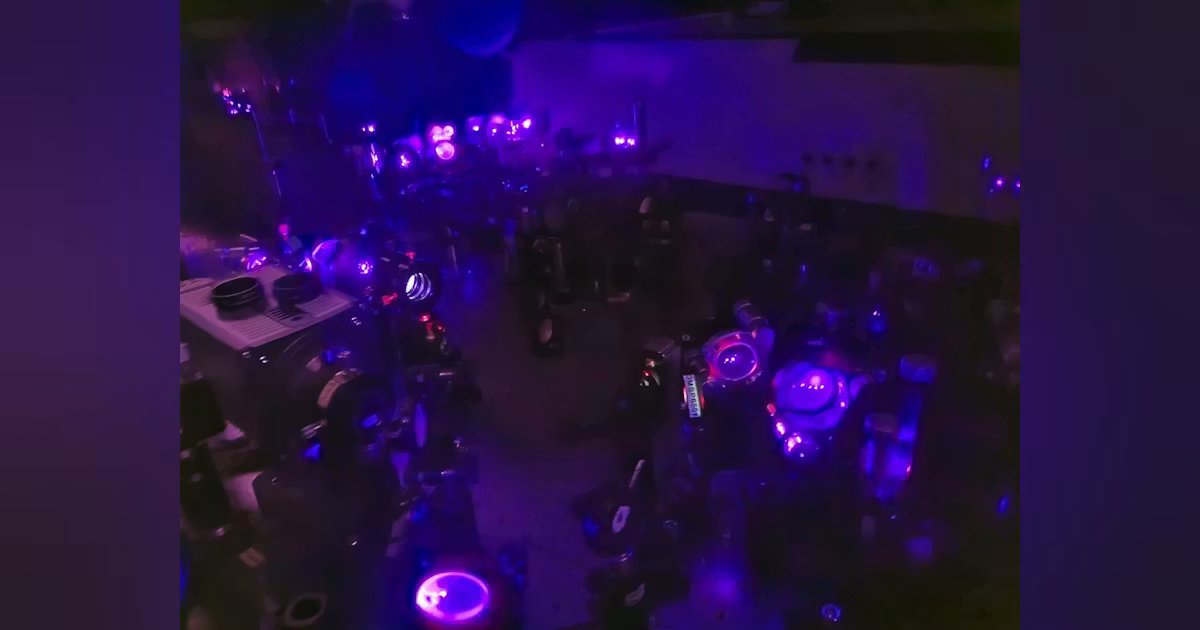
Traveling-wave optical parametric amplifiers allow the group to generate and detect squeezing. Unlike waveguide- or cavity-based systems, “this approach supports spatial coupling over a wide range of angles and transverse positions,” says Kalash. “It’s highly advantageous for generating and manipulating spatially multimode light, but it also makes the optical alignment particularly challenging. After several years of working with these systems, we’ve developed the experience needed to align and operate them reliably.”
Quantum scaling
The researchers’ multimode squeezed light method can support a wide range of quantum technologies—including “quantum computing, quantum communications and teleportation, as well as quantum-enhanced metrology, sensing, and imaging,” says Kalash. “Its key advantage is the ability to access many quantum modes simultaneously and in real time.”
Next up, the group plans to extend MOPA-based detection beyond squeezed states to more complex non-Gaussian quantum states. “We’ve already taken the first step with single-photon states, and a future goal is to address multimode non-Gaussian states and Schrödinger-cat states, which are key resources for universal quantum information processing,” he adds.
FURTHER READING
M. Kalash, A. Sudharsanam, M. H. M. Passos, V. Parigi, and M. Chekhova, Nat. Commun., 17, 3904 (2026); https://doi.org/10.1038/s41467-026-72357-0.
M. Kalash, U.-N. Han, Y.-S. Ra, and M. V. Chekhova, arXiv:2508.04502v1 (Aug. 6, 2025); https://doi.org/10.48550/arXiv.2508.04502.