
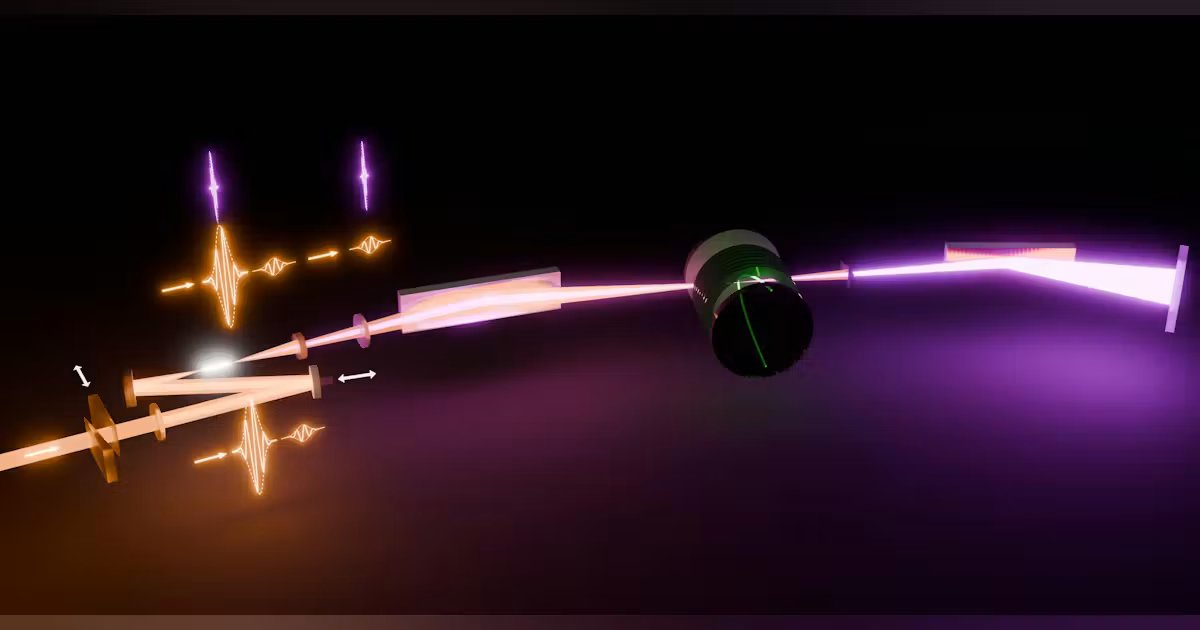
A group of researchers led by Meng Han, an assistant professor of physics at Kansas State University, recently generated and characterized 18-attosecond isolated light pulses—and these are believed to be the shortest light pulses experimentally measured so far.
Ever-shorter and brighter light pulses are a holy grail for ultrafast science, because these pulses offer a better temporal resolution to observe the electron-scale world within atoms, molecules, and materials.
“An attosecond is 10-18 seconds, which is the natural timescale of electron motion,” says Han. “If we want to directly observe how electrons move and interact, we need a ‘camera’ with an extremely fast shutter—and attosecond light pulses provide it. Our motivation was to create the shortest light pulse possible and also make it bright and stable enough to be useful for experiments.”
It starts with a Yb laser
The group’s approach begins with a high-power ytterbium (Yb) laser, which is known for its excellent stability and scalability. “We first compress its pulses to a few femtoseconds, and then use them to drive high-harmonic generation in helium gas,” explains Han. “The strong laser field drives electrons away from atoms and then draws them back. When the electrons recombine with their parent atoms, they emit an extremely short burst of high-energy light through this high-harmonic generation process.”
A very short pulse requires a broad range of frequencies, akin to combining many musical notes with precisely controlled timing. When all frequencies are synchronized properly, they can form an extremely short burst in time. “For our experiment, we generated an exceptionally broad extreme-ultraviolet (EUV) and soft x-ray spectrum and carefully controlled its spectral phase to compress light into an 18-attosecond pulse,” he says.
Producing an extremely broad spectrum that extends from the EUV into the soft x-ray region enables the researchers to “optimize and control the spectral phase of this radiation so different frequency components arrive together in time,” Han says. “And we characterize the pulse using an angle-resolved attosecond streaking technique on helium atoms, which allows us to accurately reconstruct its temporal profile. By using this approach, we measured an isolated light pulse with a duration of 18 attoseconds.”
A big surprise for the group was how far they could push a Yb-based laser system. “Yb lasers are widely known for their stability and high average power, but they certainly weren’t associated with generating the shortest attosecond pulses before now,” Han says. “Our ‘aha!’ moment was that after strong pulse compression and careful optimization of high-harmonic generation, this extremely stable laser platform can produce an extraordinarily broad and coherent spectrum—broad enough to support pulses below 20 attoseconds.”
There are still a few hurdles to clear, and making the pulse extremely short is only one part. “For many applications, we also need attosecond pulses that are brighter, more stable and controllable, and available at higher repetition rates,” Han points out.
Another challenge is to extend these capabilities to even higher photon energies—while maintaining high photon flux. And also to precisely control properties such as polarization, waveform, and spatial structure. “Ultimately, we want attosecond sources to become reliable tools that scientists can use routinely, rather than for specialized experiments that require extensive optimization,” he adds.