
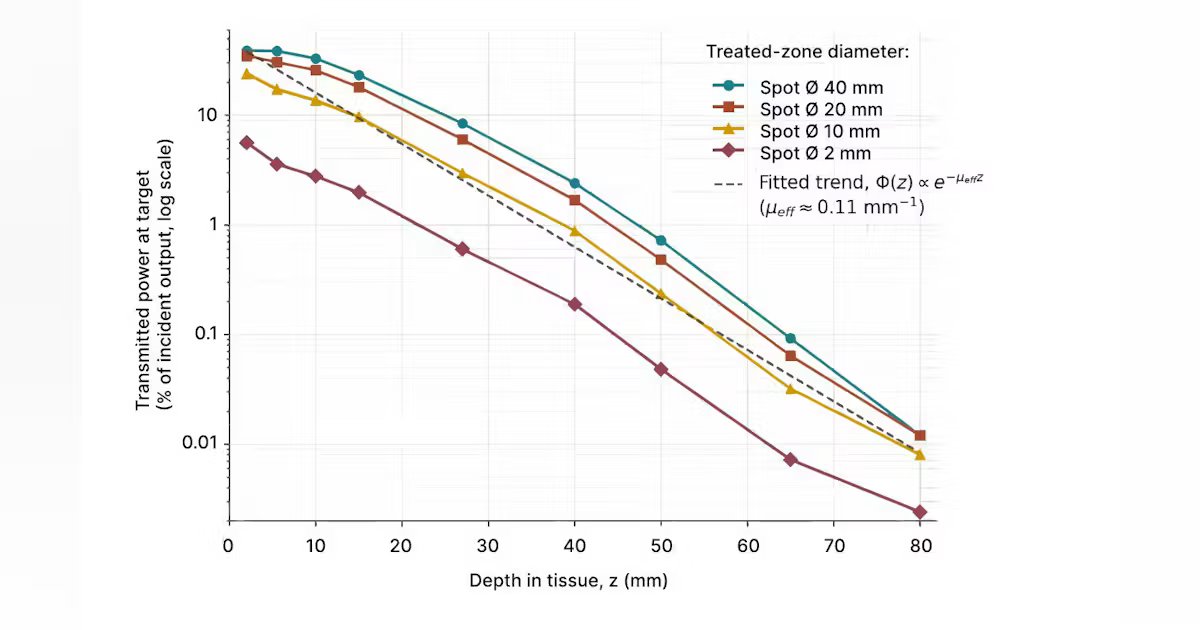
Each channel drives a separate collimated applicator, allowing nerve, spinal cord, and muscle targets to be treated in one session with channel-specific exposure times. Because transmitted power falls by more than an order of magnitude between 15- and 40-mm depth, the console derives per-channel dose from the selected anatomical site and applicator aperture rather than from a single global setting—the reproducibility gap left by existing commercial PBM devices.
Practical design targets follow directly from the clinical protocol: A stable 780-nm center wavelength with drift below 1 nm across the treatment session, 250-mW CW wave output held within a few percent over multi-hour exposures, thermal management sufficient to keep skin-surface temperature rise negligible, and per-channel optical monitoring so that an aperture blocked by patient movement is detected rather than silently reducing delivered dose.
From bench to market
In the U.S., PBM devices are regulated by the Federal Drug Administration (FDA) as Class II devices, cleared through the 510(k) pathway on the basis of substantial equivalence; in the European Union, the device falls under Regulation (EU) 2017/745 as Class IIa, requiring notified-body audit and CE marking. Neither pathway requires a full Premarket Approval, and the completed randomized trial exceeds the clinical evidence typically expected for a Class II submission. The engineering work that remains is verification rather than discovery: Wavelength and power stability during the 21-day protocol, IEC 60825-1 laser-class documentation, IEC 60601 electrical and usability compliance, and calibration traceability for each output channel.
Independent analyses place the global peripheral nerve injury market at USD $2.98B in 2026, forecast to reach USD $4.30B by 2031 at a 7.6% CAGR,11 with the seven major markets valued at ~USD $2.4B in 2023. In the U.S. alone, the market is projected to grow from USD $501M (2025) to USD $1.05B (2035).12 Established PBM manufacturers have concentrated on pain management, wound healing, and dermatology, leaving the peripheral nerve segment without a dedicated commercial device. A validated 780-nm platform enters an underserved indication as first mover, and a peripheral-nerve clearance would serve as a predicate for diabetic neuropathy, post-surgical recovery, and compression neuropathy.
Call for industrial partnership
Four decades of work have converged on a defined operating point: 780-nm, 250-mW, transcutaneous multisite delivery validated in a randomized placebo-controlled trial and now built into a third-generation clinical workstation. The remaining work is industrial, not scientific.
A partnering organization would inherit a translation-ready package: A validated wavelength and dosimetry, a published clinical protocol, a device design refined through three generations of clinical use, and a peer-reviewed evidence base spanning mechanism, preclinical models, and a placebo-controlled randomized trial. The authors are open to licensing the workstation technology and its intellectual property, codevelopment, manufacturing partnerships with medtech and photonics OEMs, and regional distribution agreements.
Enquiries are welcome from medtech OEMs, photonics manufacturers, and rehabilitation device companies. Please contact the authors to review the technical dossier, regulatory pathway, and evidence base.
REFERENCES
1. S. Shi et al., Front. Neurol., 16, 1669662, 1990–2021 (2026).
2. See www.delveinsight.com/report-store/peripheral-nerve-injuries-market.
3. S. Rochkind, A. Goldlust, and M Almog, Brain Spine, 6, 106115 (2026).
4. S. J. Hasani et al., Biochem. Biophys. Rep., 45, 102514 (2026).
5. S. Rochkind, Photomed. Laser Surg., 35, 11, 604–615 (2017).
6. T. I. Karu and S. F. Kolyakov, Photomed. Laser Surg., 23, 4, 355–361 (2005).
7. Photomed. Laser Surg., 25, 5, 436–442 (2007).
8. R. Hanna et al., J. Clin. Med., 15, 3, 1304 (2026).
9. S. Rochkind et al., Photomed. Laser Surg., 25, 3, 137–143 (2007).
10. M. M. Mandelbaum-Livnat et al., Photomed. Laser Surg., 34, 12, 638–645 (2016).
11. See www.mordorintelligence.com/industry-reports/peripheral-nerve-injuries-market.
12. See www.novaoneadvisor.com/report/us-peripheral-nerve-injuries-market.