
Nearly every global automaker—Mercedes, Toyota, Hyundai, BYD, GM, Ford, and others—are integrating LiDAR into next-generation vehicles. The only notable exception is Tesla, and even their position may eventually change.
Front-facing LiDAR will soon be standard on nearly every make and model, while rear and side LiDAR will increasingly appear on mid- to high-end platforms. FMCW’s performance advantages make it a clear long-term choice for safety-critical automotive systems.
Power, thermal management, and the importance of photonics platforms
Power consumption is one of the most critical differentiators between ToF and FMCW architectures—especially for electric vehicles, where every watt of load directly reduces driving range. This is where the choice between three main photonics platform becomes decisive.
Planar light wave circuits (PLCs), the platform Enablence specializes in, offer a uniquely powerful combination of efficiency, stability, and scalability. PLC technology does not require the thermal tuning overhead of silicon photonics or suffer from thermal drift challenges that plague other material platforms. The result is a photonic architecture that maintains optical performance across extreme automotive temperature swings (while consuming dramatically less power).
Silicon photonics requires constant thermal tuning to maintain wavelength stability, which adds significant power overhead and system complexity.
Silicon nitride offers good optical stability, but typically requires hybrid integration and does not match PLC’s intrinsic thermal efficiency at scale.
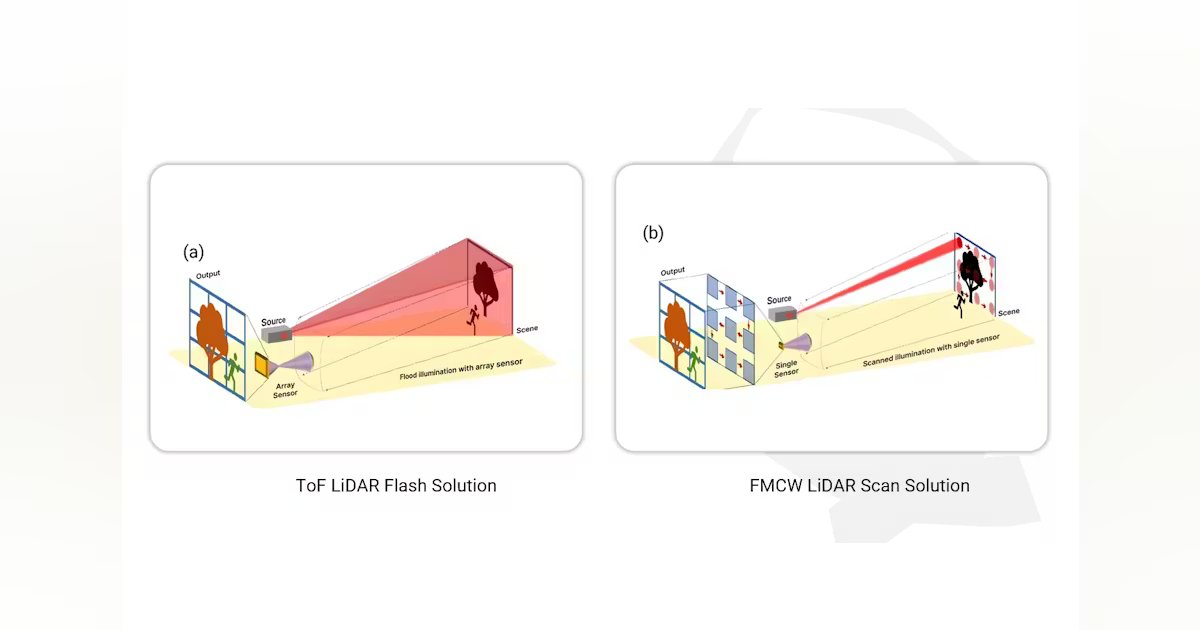
Because FMCW LiDAR extracts velocity directly from the coherent signal, its compute requirements are inherently lower than ToF systems, which must run large, power-hungry AI inference stacks to interpret captured frames. When combined with the exceptional power efficiency and thermal resilience of PLC photonics, FMCW LiDAR delivers longer range with lower total system power. The result? FMCW delivers longer range with lower total system power, which is critical for EVs.
Regulation: A coming wave favors FMCW
Today, regulatory requirements for LiDAR are modest and focus primarily on eye-safety limitations. But this landscape is about to change.
With more than 2,000 camera-related safety incidents involving current systems under review by the U.S. National Transportation Safety Board, it’s increasingly clear that camera-only or camera-radar approaches can’t reliably deliver the safety levels required for widespread autonomy.
Based on privacy and safety precedents in other sectors, we should expect mandatory multimodal sensing, requirements for long-range detection, and potential standards specifically favoring FMCW accuracy.
New regulations—particularly in Europe and the U.S.—coming within the next 36–60 months will significantly accelerate FMCW adoption.
The ‘LiDAR’ road ahead?
LiDAR adoption will intensify, and the advantages of FMCW LiDAR are clear: Superior range and resolution; instantaneous velocity measurement; higher reliability and safety; lower power consumption; strong performance within adverse conditions; and lower compute requirements.
The combination of cost reduction, integration, and performance makes FMCW LiDAR not just an improvement, but an inevitable next step in sensing technology.
At Enablence Technologies, we’re proud to help drive this evolution. As more manufacturers integrate advanced photonics, and as the market shifts toward solid-state FMCW LiDAR platforms, we’re entering a new era—one in which sensing will become as reliable and predictable as the roads and airways demand.
This technology will save lives, enable safer transportation systems, and expand the boundaries of what autonomous machines can achieve. And it’s happening now—faster than anyone expected.