
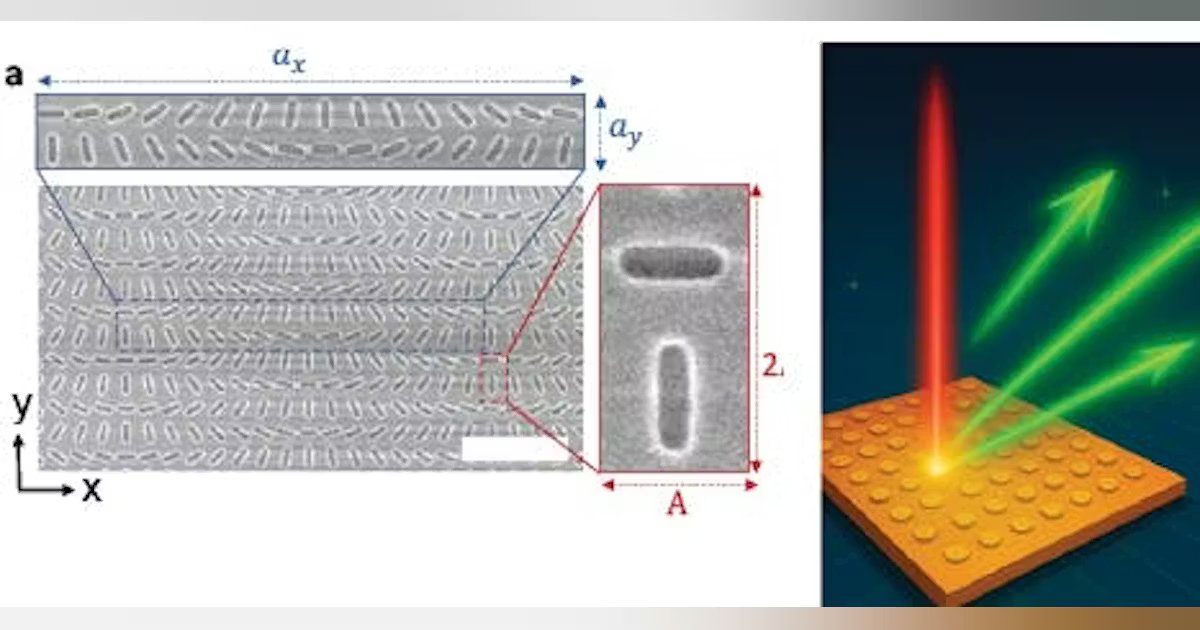
The injected pump field-generates third-harmonic radiation within the visible (close to 500 nm) inside the silicon, which inherits the pump’s phase gradient. This gives rise to nonlinear polarization currents that scatter the third harmonic to the far field in a direction dictated by the engineered phase gradient. Because the phase gradient of the third-harmonic field is dictated by the chirality of the pump, it can be used as a dial/knob to control the emission direction of the generated light.
“Beyond achieving efficient beam steering of third-harmonic generation controlled by pump chirality, another important feature of our device is that the emitted signal remains linearly polarized while it gets steered—unlike previous nonlinear metasurfaces—and it’s an important requirement for many applications,” says Alù. “It was great to verify experimentally that the nonlinear geometric phase scales as 6x the geometric phase, which enables precise control of the generated wavefront.”
Biggest challenges involved in this work? Fabrication precision and thermo-optic effects. “These effects are due to a coherent and collective behavior of all features within one macro unit cell. Small deviations in aperture dimensions can affect diffraction order intensities during fabrication,” Cotrufo explains. “And at high pump powers, heating can shift the resonance and lower efficiency.”
Simulations were “critical for various steps of this work,” says Alù. “While our designs are rationally conceived, optimization of the nanostructures is essential. We used the eigenmode analysis to identify and optimize qBIC modes with large Q-factors, linear response simulations to predict transmittance spectra and phase control, and nonlinear simulations to model third-harmonic generation by computing nonlinear polarization currents and far-field emission. They guided our design choices and validated experimental observations.”
New paradigm for nonlinear metasurfaces
The team’s work introduces a new paradigm for nonlinear metasurfaces because it “combines high efficiency (via nonlocal resonances) with wavefront control (via geometric phase), eliminates phase-matching constraints to enable compact devices, and opens pathways for programmable nonlinear optics within classical and quantum domains,” says Alù.
This approach may find applications in on-chip optical computing because nonlinear metasurfaces can perform frequency conversion and wavefront shaping within ultrathin platforms to enable compact optical logic and signal processing. Its potential for generating entangled photon pairs with tailored spatial properties also looks promising for quantum photonics. And AI and data centers can benefit from the efficient wavelength conversion and beam steering for integrated photonic interconnects.
“In general, our metasurface can provide low-power nonlinear operations for neuromorphic and analog optical computing,” says Alù.
Next?
In the short term, Alù and his team plan to expand the concept to broader resonances and different materials with stronger nonlinearities such as gallium arsenide (GaAs) and multi-quantum wells. “We’ve done a lot of work on these material platforms within the context of nonlinear local metasurfaces and want to extend it to nonlocal geometries,” he says.
A little further out on the horizon, expect to see the team integrate it with waveguides for on-chip photonic circuits and analog optical computing or even possibly develop multifunctional nonlinear metasurfaces for optical computing and quantum information processing.
This work received support from the U.S. Air Force Office of Scientific Research, the Simons Foundation, and the European Research Council.
FURTHER READING
M. Cotrufo, L. Carletti, A. Overvig, and A. Alù, eLight, 6, 5 (2026); https://doi.org/10.1186/s43593-025-00116-7.