
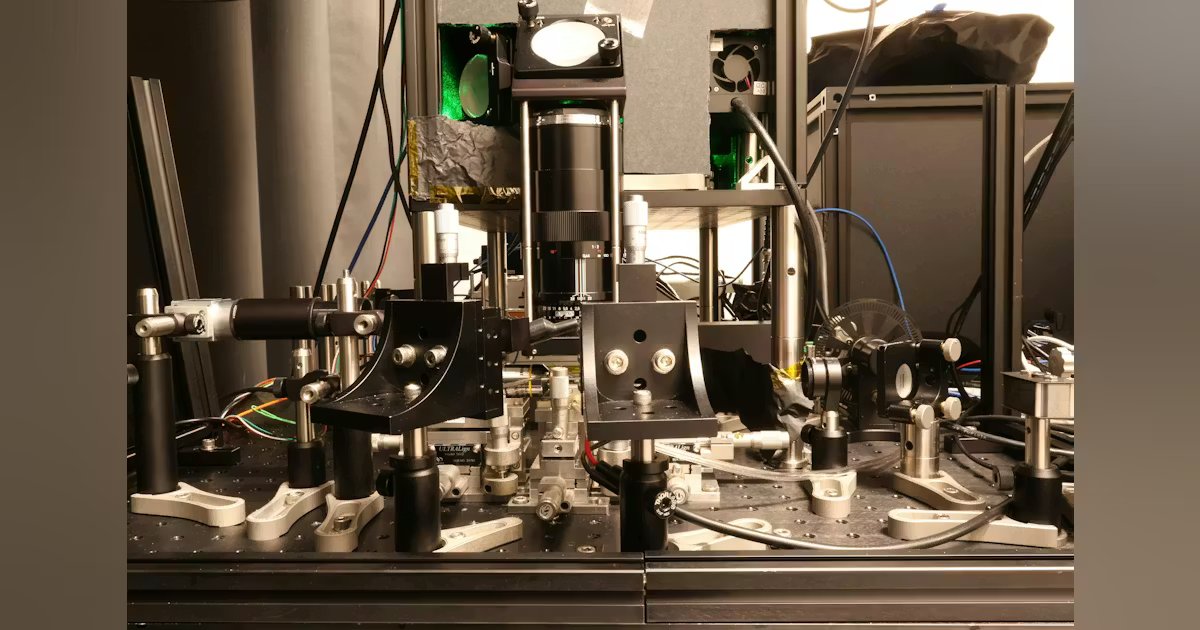
A collaboration between NTT Research, Cornell University, and Stanford University researchers led to the first programmable nonlinear waveguide that can switch between multiple on-chip nonlinear optical functions—and it’s a gamechanger for the way nonlinear photonic devices work. It essentially blows up the “one device, one function” paradigm.
The team’s programmable nonlinear waveguide uses a silicon nitride core—and its nonlinearity can be dynamically modified via structured light patterns. Structured light creates specific patterns of optical nonlinearity—that determine its function—when projected onto the device. Different patterns mean that several nonlinear optical functions can be used on a single chip.
It’s intriguing in many ways, particularly because it shows potential to bring the benefits of nonlinear optics to large-scale optical circuits, widely tunable classical and quantum light sources, reconfigurable quantum frequency conversion, and arbitrary optical waveform synthesizers.
Laser Focus World: What inspired your work with on-chip nonlinear photonics?
Ryotatsu Yanagimoto: One important innovation that enabled our demonstration was the lithography-free photoconductive electrode, which we used to program the device’s functions. Logan Wright, a co-author of this work, came up with the idea—drawing inspiration from the techniques in biology, where they manipulated cells using electric fields controlled by photoconductors.
LFW: Can you describe the basic concepts involved in this work?
Yanagimoto: This device uses physics known as electric-field induced second-order nonlinearities. Within the presence of a bias electric field, the field breaks the inversion symmetry of a material and induces second-order optical nonlinearities. Using this effect, the task of achieving programmable nonlinearity can be reduced to a realization of programmable electric fields, which we implemented using a lithography-free photoconductive electrode.
Our current demonstration of the device didn’t involve quantum functions, but programmable nonlinearities could, in principle, be used to generate quantum states of light. We theoretically estimated the generation rate of biphoton states and found that our device could achieve programmable entangled photon sources with competitive performance in the future.
LFW: What did your design work involve and how big of a focus was scaling?
Yanagimoto: The design of our device requires careful engineering of optical, electric, and mechanical properties of the materials. For instance, the photoconductor needs to exhibit the right amount of conductivity when programming illumination is shone onto it, while also having low-enough film stress. It’s also essential to select a core material with a large transparency window, low loss, and high effective nonlinearity when a bias electric field is applied.
Because of the nature of our work as a proof of concept, we didn’t focus much on scaling the device. But one of the big advantages of programmable photonics is its high production yield, because fabrication errors could be post corrected. In this sense, we expect our technology has potential to be scaled to be a much bigger size.
LFW: What does your advance mean for the field of nonlinear optics?
Yanagimoto: Nonlinear optics was born in 1961. After multiple decades of progress, it might seem that nonlinear optics has reached its final form. One main contribution of our work is to show the contrary by demonstrating something we’ve taken for granted as static in nonlinear optics can be very flexible and fully dynamic. Our device may look quite ‘weird’ compared to conventional devices, but it may just mean nonlinear optics still has room to evolve and, in the future, may end up completely different than its present form.