
A modular approach for quantum system engineering
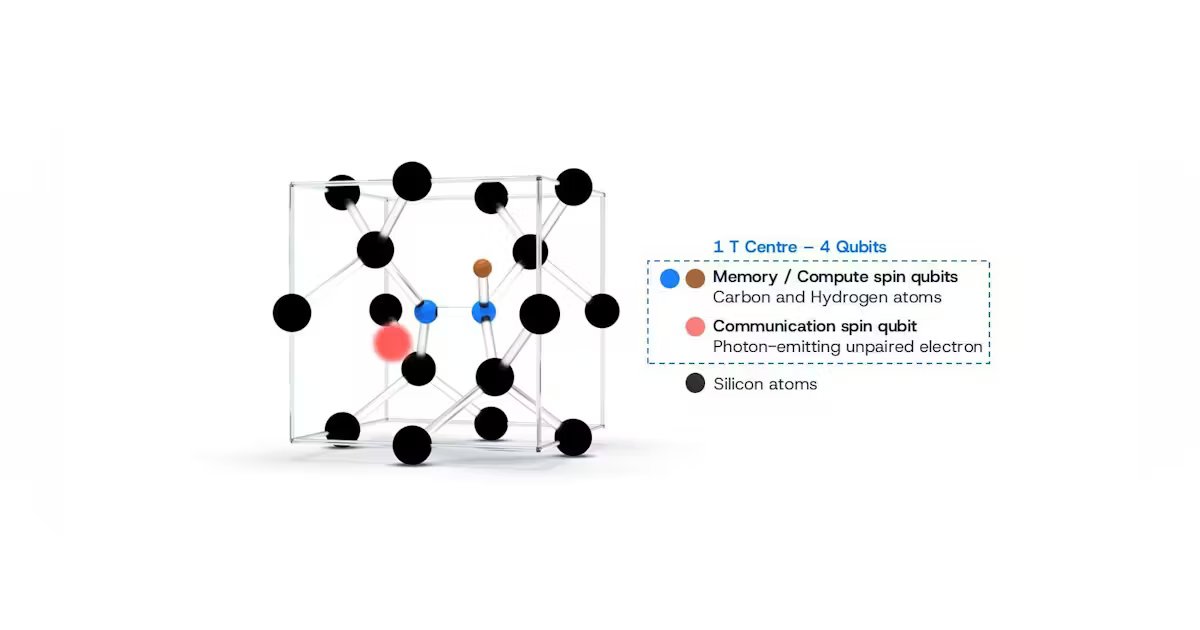
Photonic Inc.’s Entanglement First architecture is based on a modular approach for quantum system engineering. At its core, our architecture is based on a unique qubit modality, the silicon T center. This hybrid approach combines the best of silicon spin qubits and silicon photonics by leveraging the strengths of both platforms: the stability and scalability of silicon spin qubits, and the connectivity and room-temperature transmission of telecom photons. It also aligns with existing optoelectronic infrastructure, which enables integration with classical networks and data center environments.
Each T center within Photonic’s architecture is directly connected to the network and creates any-to-any connectivity. This high connectivity of physical qubits enables photons to act as “quantum messengers” between qubits. The photons generate entanglement—the quantum phenomenon in which two particles share a linked state regardless of distance—to create the connection between qubits in spatially separated T centers. This is notably different from the pure photonic qubit approaches in which the photon is the “quantum message,” where the quantum information is encoded directly within the photon itself.
High-density and high-connectivity design
The integration of photonic cavities, waveguides, and superconducting nanowire single-photon detectors (SNSPDs) onto silicon photonic integrated circuits (PICs) is central to the architecture’s performance. T centers are hosted within photonic cavities which enhance photon emission rates, improve photon collection efficiency, and reduce crosstalk, while waveguides and switches enable dynamic routing of entangled photons on-chip. SNSPDs, known for their efficiency and low dark count rates, ensure accurate detection and heralding of entanglement events. Off-chip routing is achieved by interfacing on-chip waveguides to optical fiber, which is then used for routing photons through switches between the modules.
This high-connectivity design supports both on- and off-chip quantum operations, which allows modules to be flexibly interconnected. The modularity enabled by the architecture simplifies scaling—rather than building ever-larger monolithic quantum processors, multiple modules can be linked across telecom fibers to support both quantum computing and quantum networking applications.
Error correction and fault tolerance: Leverage connectivity
Quantum systems are inherently sensitive to noise and operational imperfections. Achieving fault tolerance requires simple, fast, and efficient sophisticated error-correcting codes, which traditionally require large numbers of physical qubits per logical qubit. Our architecture enables a significantly more efficient type of error correction known as quantum low-density parity check (QLDPC) codes. It requires far fewer physical qubits for the same level of error correction compared to traditional approaches.
This efficiency is only possible because of the architecture’s any-to-any connectivity, which removes the constraints of nearest neighbor connections required by other codes. By distributing and consuming entanglement between qubits, the system supports advanced error correction methods essential for reliable, large-scale quantum computation.
Modularity, connectivity, and error correction
As quantum technologies continue to evolve, engineering choices around modularity, connectivity, and error correction will be critical to achieve the full potential of quantum technologies.
The journey to commercial-scale quantum systems is defined by the ability to scale—both up and out. By focusing on high connectivity, easy manufacturability, and data center compatibility via treating photons as the backbone of quantum communication, modular architectures like ours are helping bridge the gap between small-scale systems and full-scale commercial deployment. Photonic’s modular architecture also meets the requirements for quantum repeaters for long-distance communication of quantum information and scalable quantum networks.