
How it’s going
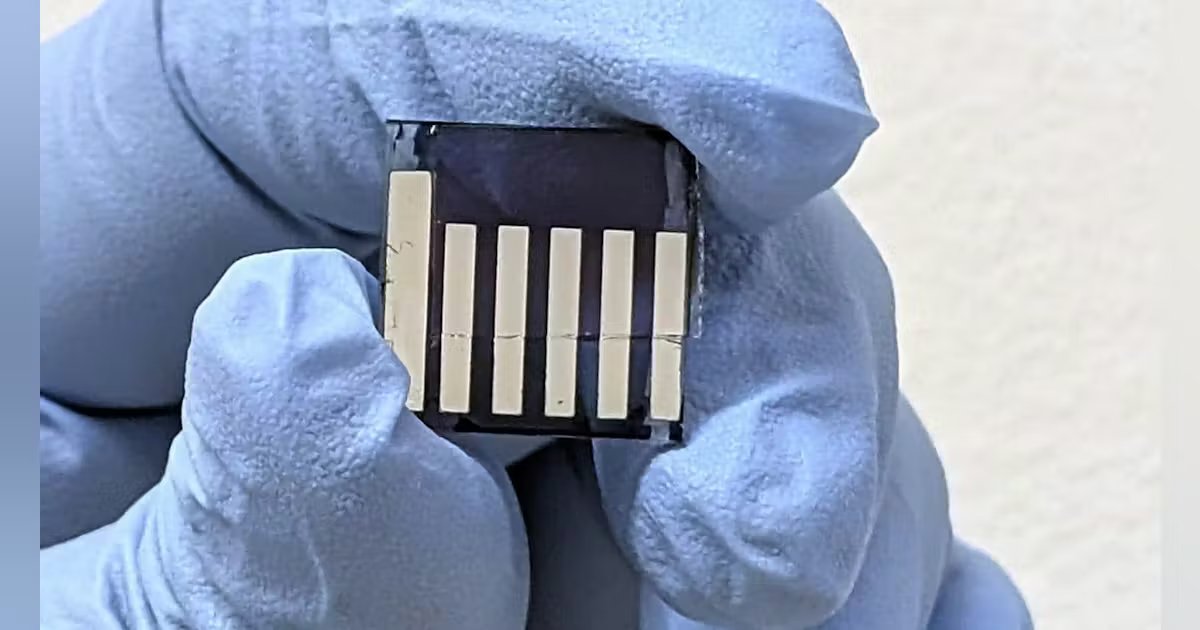
The pixel-sized spectrometer operates very quickly; the entire process happens in less than a millisecond. And it’s already proven to be as accurate as conventional spectrometers, with sensitivity that rivals commercial photodetection devices.
“Moving to a single photodetector element allows for simple miniaturization that is very difficult to achieve using dispersive optics and filters,” O’Connor says, noting the design doesn’t need additional optical elements. “Having a monolithic, two-terminal device allows for simple integration into an array of detectors.”
While akin to a CCD camera in a smartphone, the team’s device doesn’t need RGB color filters. Instead, each pixel would have spectrometer capabilities, paving the way for a compact imaging spectrometer.
There have been demonstrations using an applied voltage to a photodetector to realize a reconstruction spectrometer, including some that use semiconductors, O’Connor points out. But he says his team’s work has produced a much more “simple and effective design that outperforms these recent remonstrations in many respects, including speed, power, bandwidth, resolution, etc.”
As a result, a wide array of applications is possible for the new tiny spectrometer.
“The spectral information from a target material provides a wealth of information,” O’Connor says.
It could be used in laboratory settings—as a microscope attachment, for example—as well as in manufacturing for quality control, and in health monitoring and other biosensing applications. There is also potential for consumer products, such as those used to treat skin conditions, food quality detection, or to identify early stages of plant disease. Other possibilities include monitoring car exhaust, inspecting dyes used in foods and clothing, verifying health supplements, and security and optical encryption.
“The list goes on,” O’Connor says. “It’s exciting to think about what is possible for a powerful piece of equipment that’s usually relegated to research laboratories to be put into people’s hands. Scaling this technology down to consumer products would bring this type of scientific value to everyday uses.”