
Advanced echelle grating fabrication
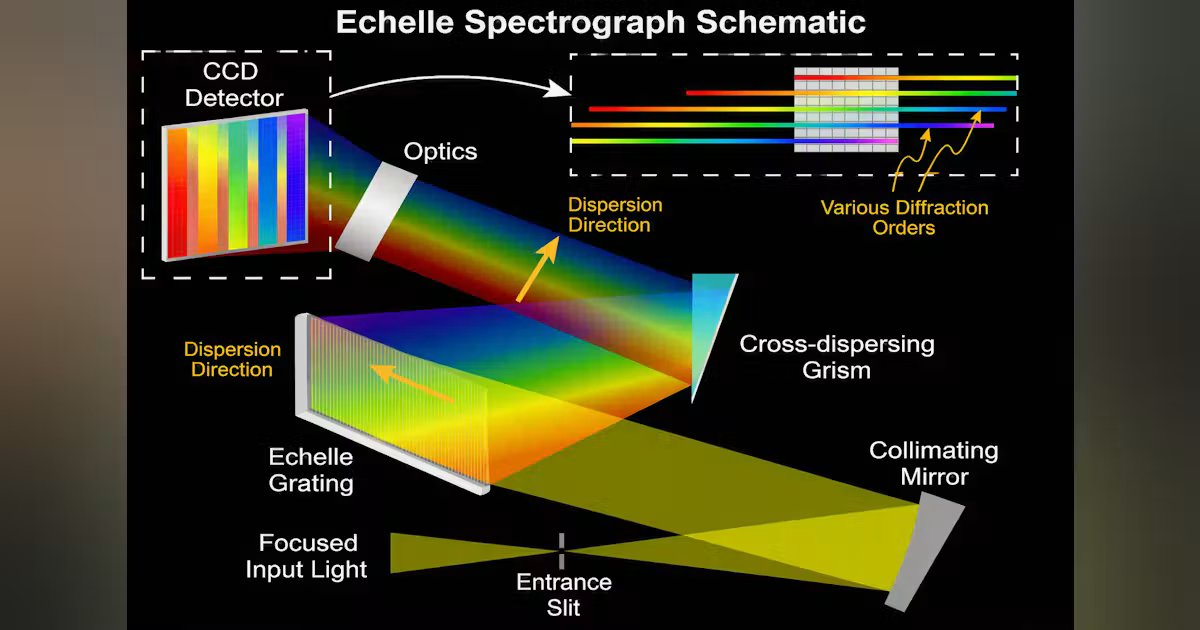
The high-precision radial velocity spectrograph requires both high resolving power and wide spectral coverage, and achieving it requires a grating with a low groove frequency and high blaze angle so that most of the incident light is dispersed into high orders—to provide enough wavelength separation and sufficient signal intensity for high spectral resolution sensing across a broad spectral range.
But the combination of low groove frequency and high blaze also results in deep grooves, approximately 7 µm in this case, which is a ~10x larger depth than most gratings. Fabricating a grating with all the necessary performance characteristics—blaze angle, groove depth, groove frequency, efficiency, and spectral range—is well beyond the capabilities of holographic production processes, which makes a traditional ruled grating the only option.
Producing such deep grooves presents several challenges. The burnishing tool must displace substantial volumes of material without chipping or distorting the groove walls, maintain a precise blaze angle across tens of thousands of grooves, and operate over lengthy ruling runs where even minor thermal drift or vibration can compromise accuracy. And the PARAS‑2 design raised the difficulty bar even further by requiring a grating measuring 840 × 214 mm.
The complex manufacturing process began by fabricating a 220 × 420 mm master echelle grating on the MIT B ruling engine. It was ruled onto an aluminum-coated Zerodur substrate using a diamond tool under highly stabilized environmental and vibrational conditions.
Two 214 × 415-mm replica gratings were then produced from this master. Both of these gratings were mounted and aligned onto a specialized precision fixture. Once the alignment was complete, the two aligned gratings were replicated to a monolithic Zerodur substrate to yield the required 214 × 840-mm grating.
This mounting process demanded nanometer-level alignment accuracy between segments to prevent spectral discontinuities and preserve resolving power. To achieve it, every adjustment in the relative position of the two replicas was followed by a thermal settling period of several days before reverifying alignment.
Acceptance testing of the mosaic grating showed: Peak perpendicular polarization and parallel polarization plane absolute average diffraction efficiency measured >60% for orders peaking between 398 to 697 nm, spectral resolution >700,000, and spatial resolution was <2 arcseconds. The diffracted wavefront across sub-apertures demonstrated irregularity <0.07 wave at 633 nm. The result was a large-format mosaic grating with a performance indistinguishable from a smaller 214 × 415-mm grating (see Fig. 4).