
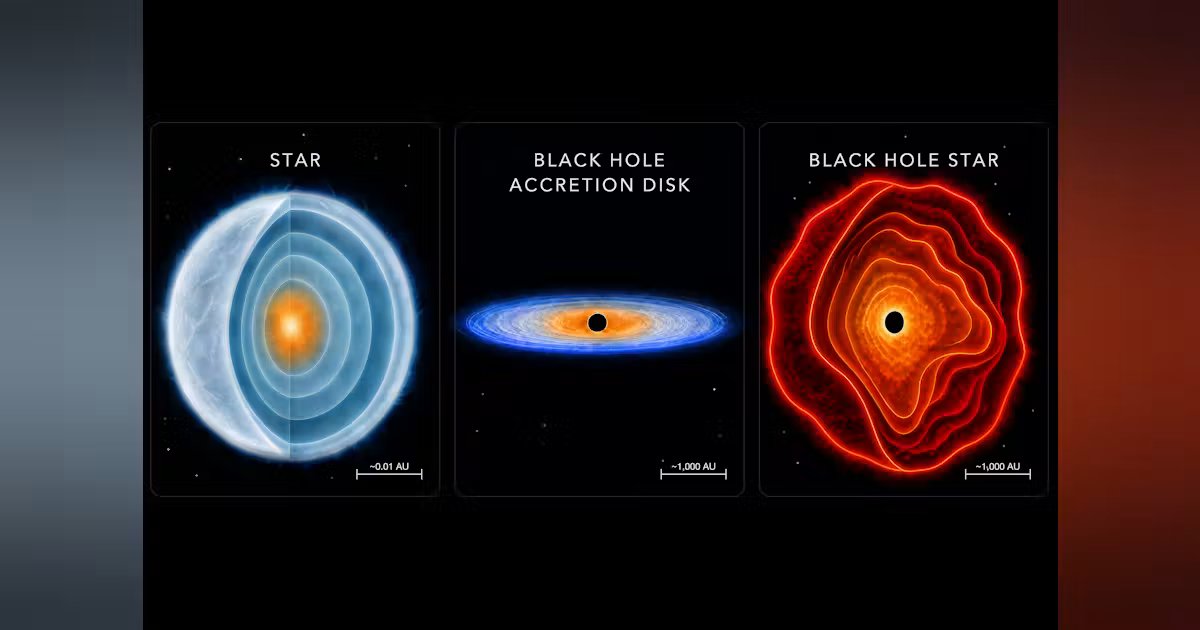
A few years ago, while using NASA’s James Webb Space Telescope (JWST) to survey some of the Universe’s earliest galaxies, astronomers noticed a peculiar and extremely bright “Little Red Dot” they’ve since concluded is a mashup of a black hole and a star.
This massive Black Hole Star cranks out 100 billion times more energy than any known star—and is more aligned with energies black holes put out.
“It’s a new type of astrophysical object—an object that radiates with the energy typically associated with black holes, but it displays some of the quintessential features of stars,” says Rohan Naidu, an assistant professor of astronomy at the University of Hawai’i now, and a NASA Hubble Fellow and Pappalardo Fellow at MIT’s Kavli Institute for Astrophysics and Space Research at the time of the discovery. “The Sun’s a ball of dense gas powered by nuclear reactions at its center, and now we may have a black hole power source enshrouded within layers of surrounding gas, paralleling the physics of stellar phenomena.”
What role did JWST play in this discovery? “Without JWST—the largest, most sensitive space telescope ever built—we would never have detected this object,” he says. “By the time it reaches Earth, all its light has shifted into infrared wavelengths unreachable from the ground. JWST’s deep images revealed this ‘Little Red Dot,’ and its powerful spectroscopy then showed us how singular it is.”