
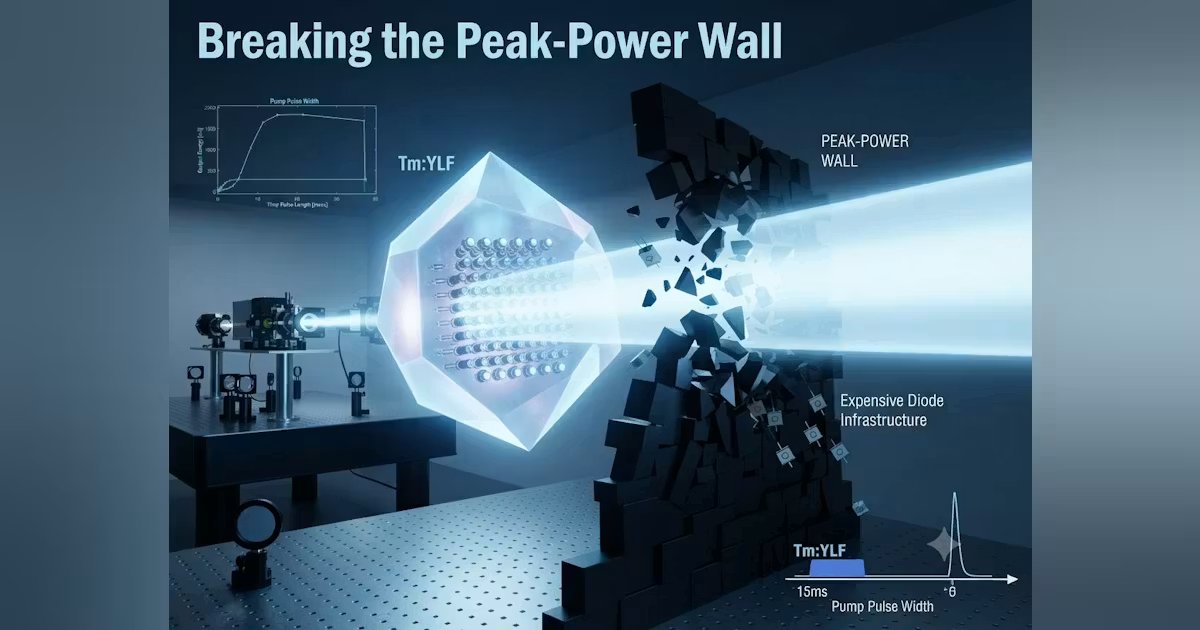
In contrast, the Tm:YLF curve scales rapidly as the pump duration is extended and reaches a clear operational threshold, where it achieves a true transparency state at a 2-ms pump duration. From this point, the output scales aggressively and climbs into the multi-joule regime and peaks around an optimized 20-ms pump window to deliver an impressive 1.75 J of pulse energy (yellow dashed line in Fig. 2). Under these operational conditions, the thulium host provides a nearly 7-fold increase in extracted energy over its ytterbium counterpart from the exact same diode stack.
For brief pump windows below 2 ms, Yb:YAG comfortably outperforms Tm:YLF. This occurs because Yb:YAG’s short fluorescence lifetime is perfectly matched to high-brightness, sub-millisecond bursts. Tm:YLF requires a much longer duration to build up an equivalent population inversion.
But scaling a Yb:YAG system upward to match the 1.75-J output of the optimized Tm:YLF amplifier exposes the peak-power wall. To force the ytterbium crystal to output 1.75 J, the required peak pump power must be increased to 32.7 kW. This represents a punishing 2.2-fold increase in peak pump power compared to the thulium configuration. Yb:YAG possesses a significantly higher emission cross-section and a lower saturation fluence, which means it can release its stored energy with greater physical ease once inverted. This partly offsets the severe storage lifetime penalty it suffers during low-frequency pump phases.
Comparative electrical-to-optical efficiency: Beyond the peak power wall
Evaluating overall electrical-to-optical conversion efficiency involves analyzing performance across four stages: Diode electrical-to-optical conversion, gain media energy storage, quantum yield, and pulse extraction efficiency.
Reaching a 1.75-J output requires approximately 15.1 kW of peak diode power for Tm:YLF, compared to 32.7 kW for Yb:YAG, so the required peak power is reduced by a factor of 2.16. When factoring in the compounding conversion efficiency losses across the diode infrastructure and power-conditioning stage, this reduction in peak electrical demand directly enhances overall wall-plug efficiency by a factor of approximately 2. Furthermore, scaling down the required peak diode power decreases the thermal load, reduces thermal dissipation requirements, and alleviates strain on the thermal management and cooling systems.
Driving the future of laser fusion
While an individual multi-joule amplifier represents a vital building block for industrial applications, the transformative scale of long-lifetime gain media extends into conceptual system architectures like inertial confinement fusion (ICF) and inertial fusion energy (IFE) systems. Achieving controlled, net-positive fusion ignition requires delivering multi-megajoule pulses of laser energy onto a target fuel pellet.
Because no single laser channel can generate megajoule-level energies without instantly destroying its own optics, fusion facilities achieve this massive energy target through spatial multiplexing. This involves arraying hundreds of individual laser beam lines, each engineered to deliver between 10 to 100 J, and firing them simultaneously so their individual pulses converge perfectly on the fusion target. For a commercial fusion power plant to be viable, this massive array must fire reliably at a repetition rate of 10 to 20 Hz. This operating frequency of 10 to 20 Hz is ideal for the Tm:YLF concept, because the extended millisecond pumping window inherently restricts this architecture to lower repetition rates where sufficient population inversion can accumulate.
Extending this framework to facility-scale designs illustrates how long-lifetime gain media could make high-repetition-rate fusion viable. By shifting plant designs to a Tm:YLF framework, facilities could exploit extended pumping windows to bypass the severe economic barriers imposed by massive diode infrastructure requirements.
Engineering the roadmap ahead
Transitioning these amplifier concepts into operational facility-scale hardware requires addressing key challenges in aperture scaling and thermal handling. Single crystal Tm:YLF or alternative holmium-doped hosts (specialized optical gain media) must be grown at larger apertures to support high energy extraction without inducing optical damage. To address the physical size limitations inherent to single crystal growth, research is examining transparent ceramic gain media, such as thulium- or holmium-doped sesquioxides, which provide uniform apertures along with improved mechanical strength and thermal fracture resistance.
Furthermore, managing localized thermal gradients and wavefront distortions over extended millisecond pump cycles will require specialized cooling loops to preserve beam quality. And ultimately, long grain lifetimes provide a viable pathway toward cost-effective high energy architectures by lowering peak diode power requirements for advanced manufacturing.
FURTHER READING
N. K. Metzger, W. M. Lee, and R. Sulkas, J. Opt., 28, 7, 075502 (2026); https://doi.org/10.1088/2040-8986/ae81c0.
I. Tamer et al., Opt. Lett., 46, 19, 5096–5099 (2021); https://doi.org/10.1364/ol.439238.
J. Vetrovec, D. A. Copeland, and A. S. Litt, Proc. SPIE, 9726, 972619 (2016); https://doi.org/10.1117/12.2220008.
W. Koechner, Solid-State Laser Engineering, 6th ed., Springer (2006); https://link.springer.com/book/10.1007/0-387-29338-8.
B. M. Walsh, N. P. Barnes, and B. Di Bartolo, J. Appl. Phys., 83, 5, 2772–2787 (1998); https://doi.org/10.1063/1.367037.
P. Loiko et al., IEEE J. Quantum Electron., 55, 1–12 (2019); https://doi.org/10.1109/jqe.2019.2943477.