
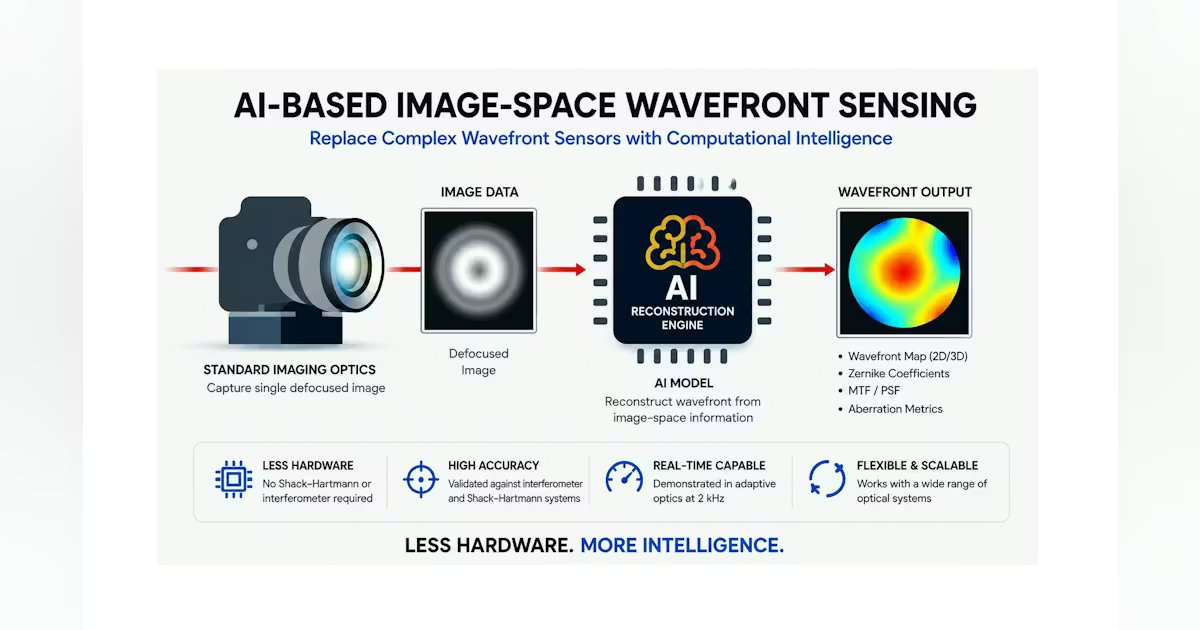
Our methodology has also been used operationally for several years by astronomers to support telescope alignment and optical performance evaluation under real observing conditions—which demonstrates the approach is effective not only within laboratory environments, but also for practical field applications under atmospheric seeing conditions (stability of the Earth’s atmosphere).
Beyond accuracy, the computational architecture also offers several practical advantages over conventional wavefront sensing methods, including reduced hardware complexity, improved robustness to vibration, high dynamic range operation, simplified system integration, and the ability to perform full-field aberration analysis in a single-shot measurement.
Real-time adaptive optics operation
One of the most significant demonstrations of our approach involved real-time adaptive optics operation at up to 2 kHz.2-4 In this implementation, the computational wavefront reconstruction engine operated directly within the adaptive optics control loop to enable high-speed wavefront estimation and correction for dynamic optical environments.
These results demonstrate that computational image-space wavefront sensing is not limited to static or offline metrology applications, but can also support real-time adaptive optics operation traditionally dominated by dedicated hardware wavefront sensors. The ability to perform wavefront reconstruction at kilohertz rates while relying only on standard imaging hardware highlights the potential of computational sensing architectures for adaptive optics, astronomical instrumentation, and other high-speed optical control applications.
Integration with optical metrology workflows
Our computational wavefront sensing framework has been integrated into a range of practical optical metrology workflows through AI4Wave and SkyWave, software platforms developed by Innovations Foresight. Because the methodology relies primarily on image-space information rather than dedicated wavefront sensing hardware, it can be adapted to a wide variety of optical configurations and imaging systems.
The approach has been applied to optical alignment, wavefront metrology, adaptive optics, optical testing, telescope performance evaluation, and autocollimator-based optical setups using both laboratory and field imaging configurations. More generally, the framework can be integrated into systems where defocused imaging data is available from the optical path under test to enable wavefront reconstruction without substantial modification of the existing optical configuration.
One practical implementation integrates AI4Wave with the Point Source Microscope (PSM) from Optical Perspectives Group, to extend the system from alignment functionality into wavefront metrology and optical performance analysis.5
Toward computational optical metrology
The increasing maturity of computational wavefront reconstruction methods opens new possibilities in optical metrology, adaptive optics, and optical instrumentation. By shifting part of the sensing architecture from specialized hardware into computational image reconstruction, these approaches can reduce system complexity and expand deployment flexibility for environments where conventional wavefront sensing hardware may be difficult to integrate, sensitive to vibration, cost prohibitive, or impractical to operate.6
Unlike traditional wavefront sensing architectures that depend on dedicated optical components, computational image-space wavefront sensing can leverage existing imaging hardware and standard optical configurations to extract wavefront information directly from a defocused image. This creates opportunities for more compact, scalable, and field-deployable optical systems across research, industrial, and astronomical applications.
As optical systems continue to evolve toward faster, software-defined, and more integrated architectures, computational image-space wavefront sensing represents a promising direction for next-generation optical metrology and adaptive optics instrumentation.
REFERENCES
1. G. Baudat and J. B. Hayes, Proc. SPIE, 11490, 114900U (Aug. 21, 2020); https://doi.org/10.1117/12.2568018.
2. G. Baudat, D. Lavanchy, and G. Müller, Proc. SPIE, 13373, 133730G (2025); https://doi.org/10.1117/12.3043339.
3. G. Baudat et al., SPIE Astronomical Telescopes + Instrumentation (Jul. 6, 2026).
4. See www.innovationsforesight.com/Wavefront/SubMillisecondAI4Wave_Wavefront_Sensing_1080pHD.mp4.
5. See https://youtu.be/mIlzEisrEMc.
6. G. Baudat and R. E. Parks, Opt. Eng., 64, 4, 044101 (Apr. 2025); https://doi.org/10.1117/1.oe.64.4.044101.