| Laser Focus World
Global coverage of photonics technologies, applications, and innovations Source link
| Laser Focus World Read More »
Laser Technology
Global coverage of photonics technologies, applications, and innovations Source link
| Laser Focus World Read More »
In this episode, Erin Howard, a research scientist currently working at the University of Washington on the Vera C. Rubin Observatory, talks with host Justine Murphy about their passion for exploring the universe through data, and the excitement in contributing to cutting-edge scientific discoveries. Following the Photons: A Photonics Podcast dives deep into the fascinating world
PODCAST: Meet Erin Howard, University of Washington and Vera C. Rubin Observatory Read More »
Changes at the optical layer Software-defined LiDAR’s level of adaptability requires a fundamentally different way of controlling light (see Fig. 2). Light control metasurfaces (LCM) enable fully electronic beam steering without mechanical motion. Unlike traditional scanning approaches, beam steering with LCM is nonsequential. The system doesn’t need to sweep through intermediate angles to reach a
Programmable optics turn sensors into perception platforms for LiDAR Read More »
This episode of Following the Photons is a technical conversation about co-packaged optics, the rapid rise of interest in this technology, and why active alignment is a major manufacturing bottleneck in photonics. The discussion, sponsored by Aerotech, focuses on the company’s new PICAlignTM approach, developed in collaboration with SENKO and Santec, which aims to improve
Podcast Chat: Co-Packaged Optics and the Active Alignment Breakthrough at Aerotech Read More »
This episode features Dr. Aleksandra Kaszubowska, an assistant professor of electronic and electrical engineering at Trinity College Dublin and an assistant professor and research fellow at the CONNECT Research Center. She talked with host Justine Murphy about the exciting work her team is doing, as well as her vast research experience and the remarkable path
Building a laser stabilization system used to mean securing a bulky, expensive analog lock-in amplifier. While effective, these systems can be limited in flexibility, latency, and integration compared to modern digital approaches. Digital devices leveraging digital signal processing outperform their predecessors, which real-world case studies have shown. Is laser stabilization’s future digital? Laser stabilization is
Laser wavelengths required for many of today’s most intriguing experiments, particularly within the visible range, are a challenge to source for tiny photonic integrated circuits (PICs). But U.S. National Institute of Standards and Technology (NIST) photonics researchers and colleagues at Octave Photonics are spearheading a solution to this wavelength access issue—and also addressing challenges to
‘Any wavelength’ lasers for PICs? Read More »
This edition features Host Justine Murphy’s chat with Dr. Brian Monacelli, a professor and director of Laser Technology at Pasadena City College in California. He’s also a principal optical engineer and supervisor of the Optical Implementation group at NASA’s Jet Propulsion Laboratory. They recently discussed things like the importance of training technicians in hands-on laboratory
In this episode of Photonics Hot List: A new terahertz imaging system developed by researchers in the U.K. is poised to become a key tool in medical diagnostics. Business news roundup: Photonics-centered startups continue to boom worldwide, with announcements of new rounds of funding. A new approach to coupling optical fibers to photonic integrated circuits
Photonics Hot List: April 24, 2026 Read More »
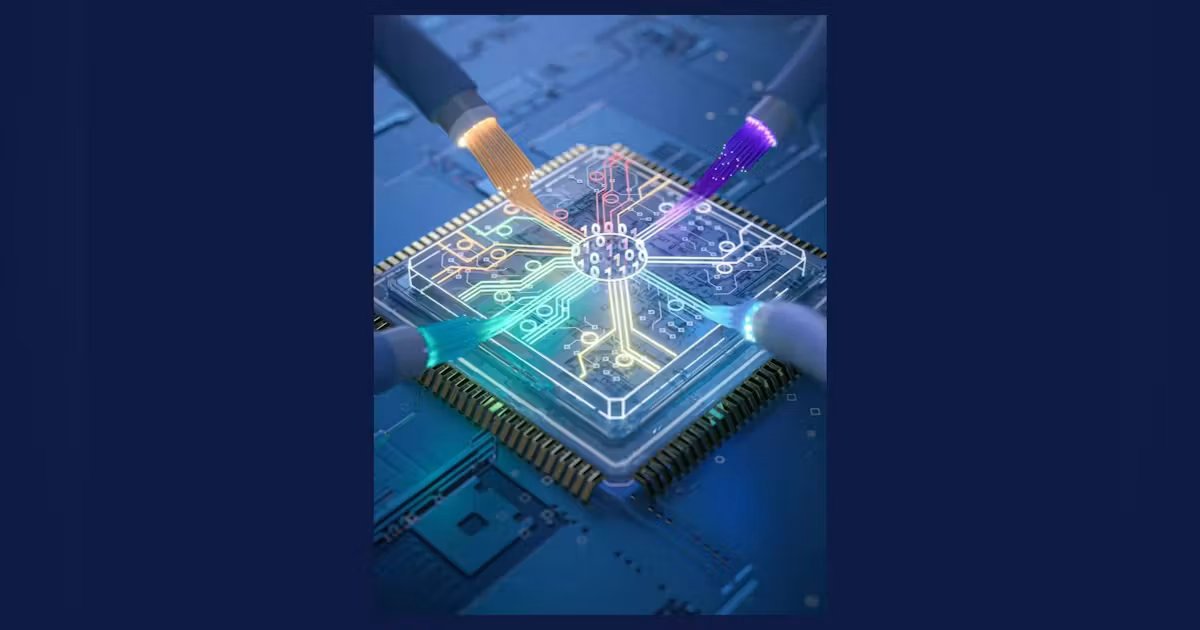
The digital world is accelerating at a pace that seemed implausible just a few years ago. Artificial intelligence (AI) models are doubling in size, which is causing data center traffic to explode and the infrastructure that powers our connected lives to strain under this unprecedented demand. Behind every AI breakthrough, real‑time analytics engine, and cloud‑scale
Cooling is critical for copackaged optics Read More »