
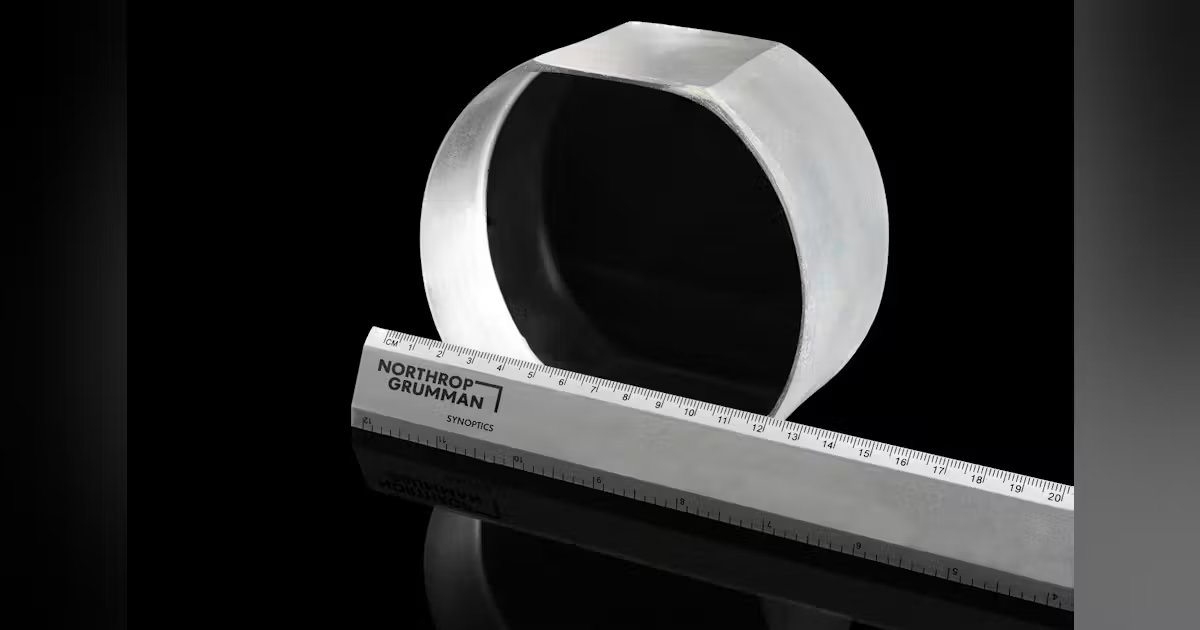
Laser fusion promises to transform the clean energy landscape, but enormous engineering challenges must first be overcome to turn laboratory breakthroughs into practical power sources. One required advance is a dramatic improvement in the efficiency of the laser source, which currently requires hundreds of times more power than the fusion reaction produces. A laser host crystal with a unique combination of properties is vital to achieve these high efficiencies, and it must be producible in large aperture sizes with unparalleled optical quality.
Northrop Grumman SYNOPTICS recently produced an ytterbium-doped yttrium lithium fluoride (Yb:YLiF4) single crystal boule with a diameter 3x larger than the industry standard. Laser crystals like Yb:YLF are the heart of solid-state laser systems and serve as the gain medium inside the laser cavity where light oscillation, amplification, and stimulated emission produce an intense beam of optical radiation.
This achievement goes beyond a materials science feat—it’s a gamechanger for fusion research. Parts from this crystal will go on to power high-energy laser systems for inertial confinement fusion (ICF) energy research at Germany’s renowned research center Deutsches Elektronen-Synchrotron (DESY). ICF creates energy with zero greenhouse gas emissions and minimal waste.
The large-diameter Yb:YLF crystal technology may ultimately power the laser systems needed to unlock fusion’s potential as a clean energy source and put humanity one step closer to harnessing star-like energy on Earth.
Art of Czochralski crystal growth
Our crystal boule was grown using a well-established Czochralski growth process, during which raw materials are heated inside an iridium or platinum crucible until fully melted, and then a rotating seed crystal is brought into contact with the melt surface and equilibrated at the melting point. The seed crystal is slowly pulled as the furnace is cooled to gradually expand the growing crystal under computer control to reach full diameter. Growth continues under constant diameter control until the desired boule length is reached, followed by tapering, extraction from the melt, and stepwise cooling to room temperature.
Many years of ongoing continuous process improvement were invested in synthesizing high-purity starting materials, adjusting the melt composition, refining the hot-zone design, and optimizing the growth recipe to maximize crystal quality and yield. The optimum conditions differ for each crystal compound, crystal size, dopant, and even dopant concentration we grow.
By far the greatest challenge of the Czochralski process is eliminating the formation and propagation of defects that degrade the optical quality and laser performance of the crystal. These defects include dislocations, grain boundaries, twins, bubbles, melt inclusions, precipitates and other scattering centers, striations, and cracks.
Beyond macroscopic physical defects, significant optical distortions can be introduced by residual stresses within the as-grown crystal. These stresses can arise from physical defects themselves, high thermal gradients during crystallization or cooldown, or from anisotropic thermal expansion properties of the material being grown. High thermal gradients, intrinsic to Czochralski growth, are magnified at large crystal sizes due to increased center-to-edge temperature differences, but they can be mitigated to some degree via reduced growth and/or cooling rates (which add cycle time), the use of after-heaters above the melt, or isothermal post-growth annealing. Some of these strategies demand complex and costly equipment or process changes, so choosing a practical and impactful approach is always a challenge.