
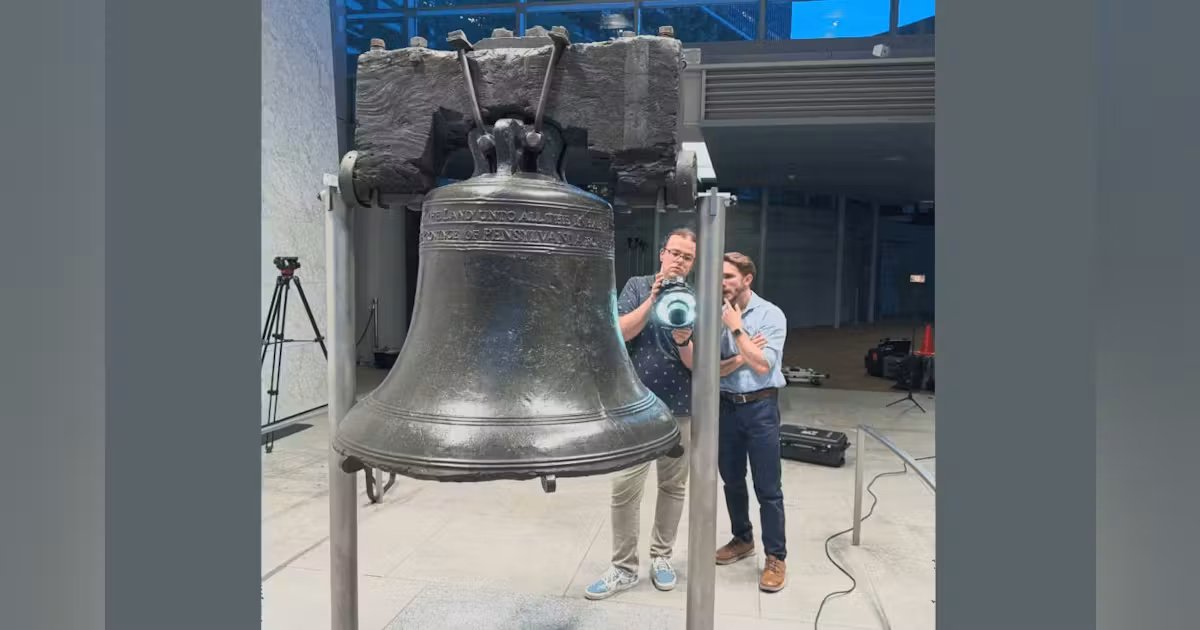
Processing the data onsite
To process the data onsite, we got a Lenovo Legion 9 with an RTX 5080 up and running from the first session to drive the scanners and give us a way to view the images and data we’d captured. A lagging machine would have cost us time when we needed to know in real time whether a pass had tracked before our window with the bell closed, not discover it two weeks later back in Erie.
After each session we opened the files before doing anything else, renamed each dataset so it traced back to scanner, session, and area, then wrote copies to the Legion, an external SSD, and the cloud. Three copies, two media, one offsite. Our scanning and photography alone have already produced hundreds of gigabytes of raw data, and it grows substantially once the VR180 and 360 video from the Insta360 Pro 2, the X5, and the Kandao QooCam 3 Ultra are transferred and processed. Between raw captures, working files, and finished experiences, this project will be well over a terabyte.
What’s the data good for?
Back in Erie, we each took one dataset through registration and cleanup. We left holes within the FARO dataset where we didn’t have data. Filled geometry looks better and means less, but anything a conservator might rely on must be honest about what it doesn’t know.
Our outputs aren’t interchangeable. A dense FARO dataset built for close geometric work is a different product from a color model built for public exploration, and the Matterport tour answers a third question entirely by preserving the relationship between the bell and the room. This distinction is the most important thing we’d tell anyone attempting something similar. Scanner specifications matter but can’t solve an occlusion or recover a pass never captured.
Most durable use? Longitudinal documentation. Artifacts change on timescales longer than any of our careers, and a detailed 2026 record gives future researchers something to work against, although any meaningful comparison will depend on how carefully any later captures and registrations are controlled.
Another reason was availability. To our knowledge, no comparable research-oriented scan of the Liberty Bell has ever been made freely available. You can see our scans and other project outputs at var.psu.edu/libertybell. Researchers, educators, and everyone interested are invited to inspect the bell from anywhere in the world and from viewpoints the visitor area doesn’t allow.
What’s next?
With a high-resolution digital twin of the Liberty Bell as it exists today, researchers can now revisit questions first explored by Penn State more than 25 years ago, including how its present-day geometry might refine models of how the cracked bell would sound if it could ring again.
This same dataset is also feeding the next phase of the project, including VR180, stereoscopic 360, and Gaussian splat experiences, as well as plans for a full-scale 3D-printed replica paired with research-informed sound. This deployment has all of us at VAR Lab thinking about which other preservation challenges could benefit from the same field metrology approach.