
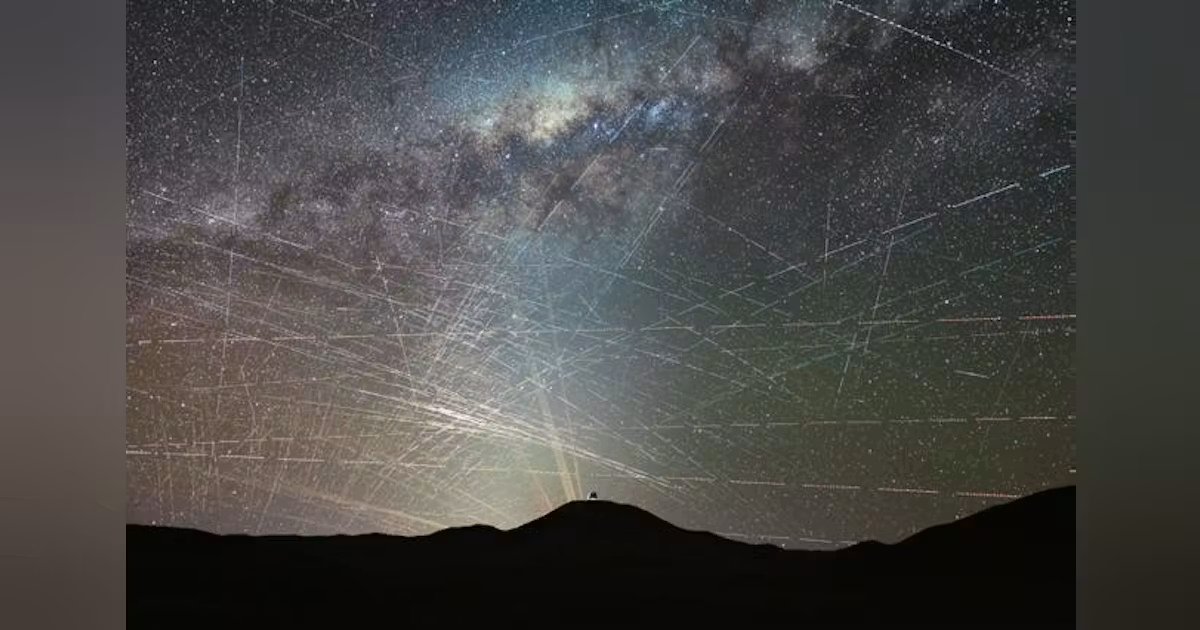
Satellite brightness will affect everyone on Earth
The number of satellites being sent into LEO is merely one aspect of the problem—an equally important one is the brightness of the satellites. “As long as they’re fainter than magnitude 7 (a weird astronomical unit for brightness; mag 7 corresponds to the brightness of the faintest star visible with the naked eye in perfect conditions), they leave a narrow trail on our image,” Hainaut explains.
When they are brighter, two things happen: Trails get broader and, in the worst case, they can affect the entire image. “Rubin’s LSST camera is particularly sensitive to this,” Hainaut says. “The camera is very wide by design and it’s what makes LSST special, so it’s particularly sensitive to satellites. To make the matter worse, Rubin’s camera—the largest in the world—packs some very high-density control electronics, which makes it susceptible to cross-talk. A very bright satellite trail will appear many times on the image—the real trail and many ‘ghosts’ caused by electronic cross-talk. Bright satellites can kill LSST.”
When light from satellites illuminate the atmosphere, “it scatters the light and makes the sky brighter—the sky is blue during the day because the atmosphere scatters sunlight,” Hainaut adds. “It’s a small effect. At night, all the light scattered from the stars contribute ~4% of the dark sky brightness. But some bright satellites are so bright and numerous they would increase the brightness of the dark sky by 200 to 300%. This gigantic amount of light pollution will affect most of the planet, not just observatories. If you go to a really dark place—deep countryside, high mountain, desert—the sky will look like what you get from the suburb of a small town, but with the addition of hundreds of bright satellites crossing the night sky.”
The two effects—trails covering images and the brightness of the dark sky—will compromise astronomers’ observations for distant galaxies. “If a trail crosses the image of the distant galaxy you try to observe, it’s lost,” Hainaut says. “And the brighter sky means you’ll need a much longer exposure to get the image—further increasing the chances to get zapped by a trail. Depending on the number of satellites, it could cost us ~30% of the data. In the worst case, with many bright satellites, essentially 100% of the data are lost and all of the investment into the observatory is lost.”
What can satellite owners do to cut brightness? “There are many discussions ongoing between astronomers and the satellite industry, and the International Astronomical Union organized a forum to meet and exchange information (see cps.iau.org),” says Hainaut.
With minor adjustments to satellite design and the way they’re oriented with respect to the sun, their “brightness can be decreased by a large fraction,” Hainaut says. “Big companies like SpaceX, OneWeb, and Amazon LEO, to mention a few, are very active and work really hard to improve the situation. It may not be enough in the case of satellites designed to be superbright on purpose—like Reflect Orbital.”
Reflect Orbital’s goal is to bring sunlight during the night via large mirrors in space. They promise never to illuminate the observatories, but it won’t protect small observatories or amateur astronomers. “Within the beam it will be daylight,” Hainaut points out. “Even outside the beam, the satellites will be superbright—like Venus, the ‘morning star.’ It’s too bright and will cause enormous light pollution.”