
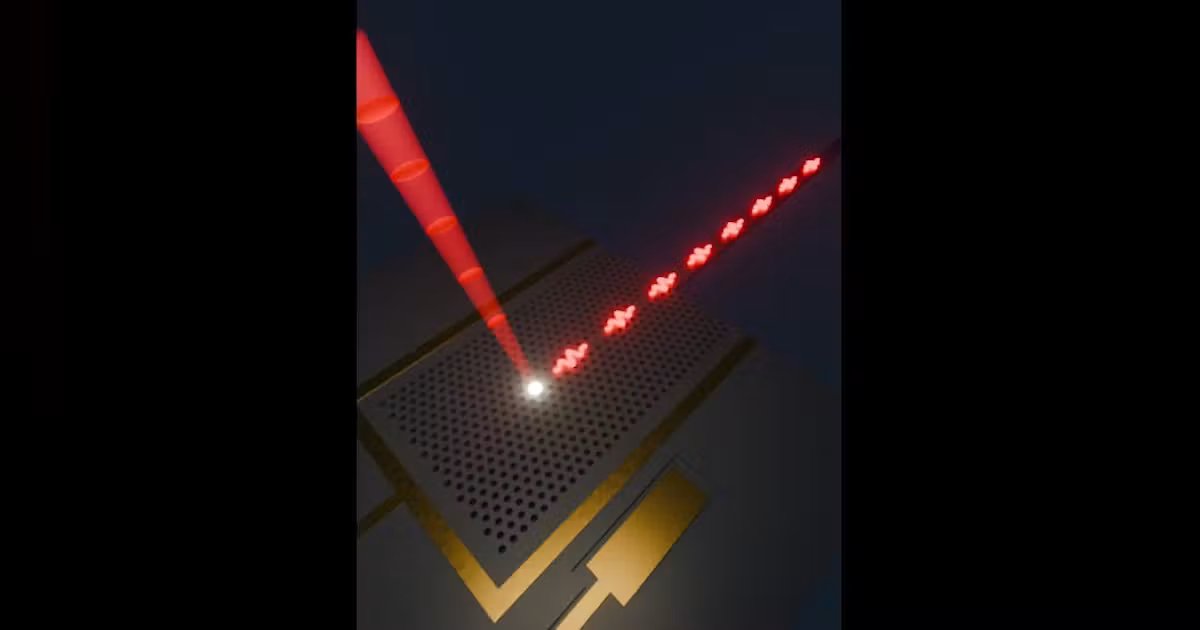
Lasers are the powerhouse of photonics: Coherent, powerful, and brilliant. At the other end of the intensity scale, single photons occupy a unique place in quantum technology as the only practical carriers of quantum information between distant systems. Single photons enable quantum key distribution (QKD), with security assured by quantum mechanics rather than computational assumptions, and they fuel photonic quantum computing, which requires vast numbers of identical photons.
Every application begins with a source of identical single photons on demand. Quantum dots are the premier solid-state source, but their best performance has so far been confined to near-infrared wavelengths. Bridging this interface to the telecom bands has seen decades of activity, yet the resulting photons have until now been noisy and incoherent. In our recent Nature Nanotechnology paper, we demonstrate a quantum-coherent photon–emitter interface within the original telecom band, a.k.a. “O-band,” spanning 1260 to 1360 nm, with transform-limited linewidths and more than 40 million single photons per second delivered directly into an on-chip waveguide.
Trapped at 930 nm
Our self-assembled quantum dot is a nanoscale island of indium arsenide, roughly 30,000 atoms, embedded within a gallium arsenide crystal. It confines electrons to discrete, quantized energy levels, and behaves as an artificial atom governed by the physics Niels Bohr introduced a century ago. Fittingly, much of this work took place at the institute bearing his name. Driven with a fast laser pulse, the dot is excited and then emits exactly one quantized photon when it decays.
An unknown quantum state encoded within such a photon cannot be copied, and interception introduces detectable disturbances—which makes single photons ideal carriers of secure quantum information. In the ideal limit, a source must efficiently deliver pure single photons that are also indistinguishable, meaning quantum-mechanically identical so they can interfere. Quantum dots have set the benchmarks on all three counts: Efficiency, purity, and indistinguishability.
But these benchmarks were set around 930 nm, where the highest-quality dots naturally emit. Historically, this was convenient because excellent lasers and efficient detectors were on hand. For some applications, however, this is a dealbreaker: Fiber attenuation at 930 nm is far too high for long-distance links. And silicon, the workhorse material of photonic integrated circuits, absorbs strongly below 1100 nm. The best quantum light-matter interface was incompatible with both the world’s fiber infrastructure and its most mature photonics platform.
Coherence is the decisive requirement and it is measured meticulously. The optical linewidth collects the fingerprint of every noise process in the device—from fast phonon dephasing to slow charge fluctuations. Two-photon interference, the standard test of indistinguishability, typically only probes a few nanoseconds of delay, whereas the linewidth integrates noise over millions of emission events. At the transform limit, the linewidth is set directly by the inverse lifetime and successive photons are highly indistinguishable. Despite extensive efforts, reported linewidths for telecom quantum dots stayed an order of magnitude above this limit—holding out on the promise of quantum dots.