
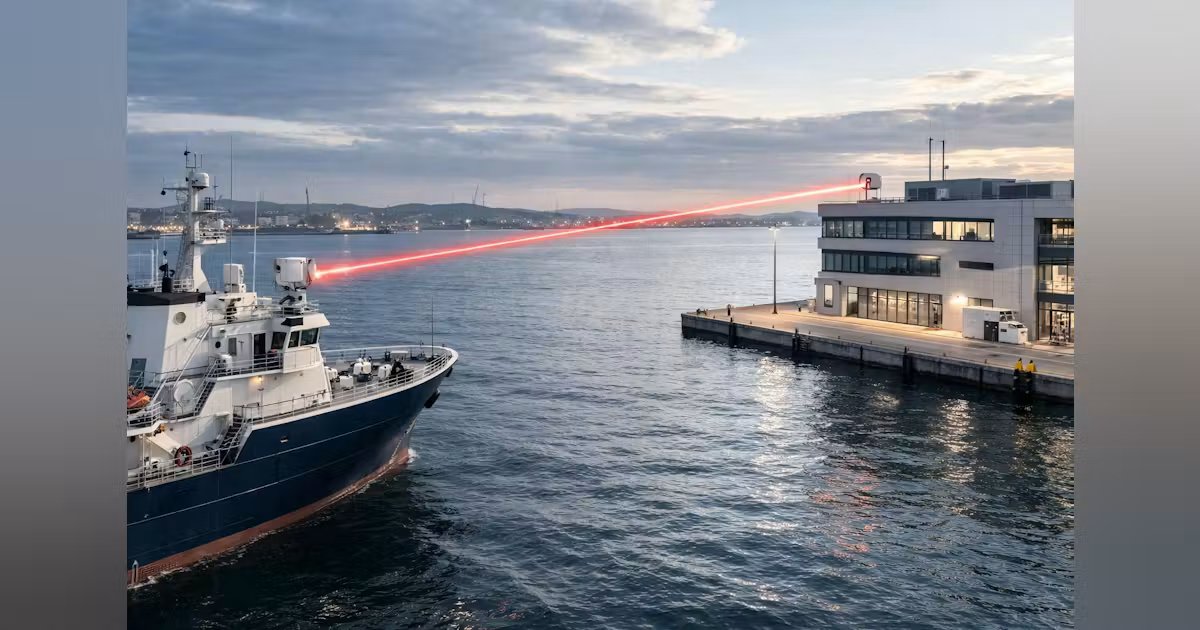
Still waiting for optical fiber at your home? For private households, this is an inconvenience. For critical infrastructure and cybersecure networks, it’s a make-or-break resource. Free-space optical QKD enables connectivity at sites and between platforms where fiber deployment is impractical or impossible—like connectivity with mobile users of critical infrastructures, across campuses, harbors, industrial areas, and temporary ad hoc networks.
The critical part is to take free-space QKD out of the laboratory. Our latest demonstration shows how it can be integrated into a practical wireless communication stack, with encryption, broadband data transport, and monitoring working together.
Why QKD? Classical public-key cryptography relies on mathematical problems that are difficult for today’s computers. Powerful quantum computers threaten widely used cryptographic methods. QKD takes another path by distributing keys using quantum states of light, so eavesdropping changes the physical system and can be detected. Properly implemented QKD provides security grounded in physics rather than computational assumptions. It doesn’t replace every security tool, but rather belongs in a hybrid future with post-quantum cryptography, classical symmetric encryption, and authentication to allow future cybersecurity certification. The goal is defense in depth for data that must remain confidential for many years.
QKD on optical free-space channels
KEEQuant adapted its commercial continuous-variable (CV) QKD devices for operation on optical free-space channels. This includes the optical coupling of a telecom-band CV-QKD signal into a free-space link, development of hardware and software interfaces for integration with key management, encryption applications, and network-management functions. This is relevant for security-critical environments because the result isn’t an isolated QKD experiment but rather a route toward deployable key delivery over line-of-sight links.
This achievement was demonstrated during a recent German research project called QuINSiDa, which involved six partners from academia and industry. The consortium set out to answer a practical question: What would happen if quantum-secure communications left its fiber environment and stepped out into the open air? The answer is a one-of-a-kind optical wireless secured communication stack that combines free-space QKD, LiFi, pointing/acquisition/tracking (PAT), key management, encryption, and network monitoring.
The stack combines several optical systems. Fraunhofer IPMS contributed LiFi and free-space terminal technology, including PAT, to acquire and maintain beam alignment. Fraunhofer IOF contributed a discrete-variable (DV) QKD system. TELCO TECH integrated encryption. Infosim brought monitoring and network management workflows. BESCom contributed use case, transfer, and dissemination expertise. Together, these pieces made the central point visible: Wireless quantum-secured communications are ripe for real-world applications.
The optical neighborhood was dense. Our demonstrator combined CV-QKD at 1550 nm within the middle of the C-band, DV-QKD at 810 nm, and LiFi within the 850- to 940-nm range. Wavelength separation as well as optical and spectral filtering allow the channels to coexist.