
Infrared (IR) fiber is sold on measurable performance. A manufacturer needs attenuation at the operating wavelength, a usable continuous length, and assurance that the fiber will withstand normal handling and service. These requirements also determine the value of producing ZBLAN fluoride-glass fiber in orbit.
ZBLAN contains zirconium, barium, lanthanum, aluminum, and sodium fluorides. Its transmission range extends into the mid-IR, beyond the useful range of conventional silica fiber. This makes it relevant to IR lasers, spectroscopy, sensing, and specialist light-delivery systems. Drawing the glass remains difficult. Crystals, impurities, bubbles, and changes in core geometry can introduce optical loss. Gravity also influences some parts of the manufacturing process—particularly convection and crystallization during heating and cooling.1,2
In 2024, the Flawless Space Fibers-1 experiment produced almost 12 km of ZBLAN fiber aboard the International Space Station. The longest continuous length reached 1,141 m. Researchers returned the material to Earth and analyzed more than 2 km of selected fiber. These are substantial engineering results that make detailed comparisons possible.2
What the flight measurements show
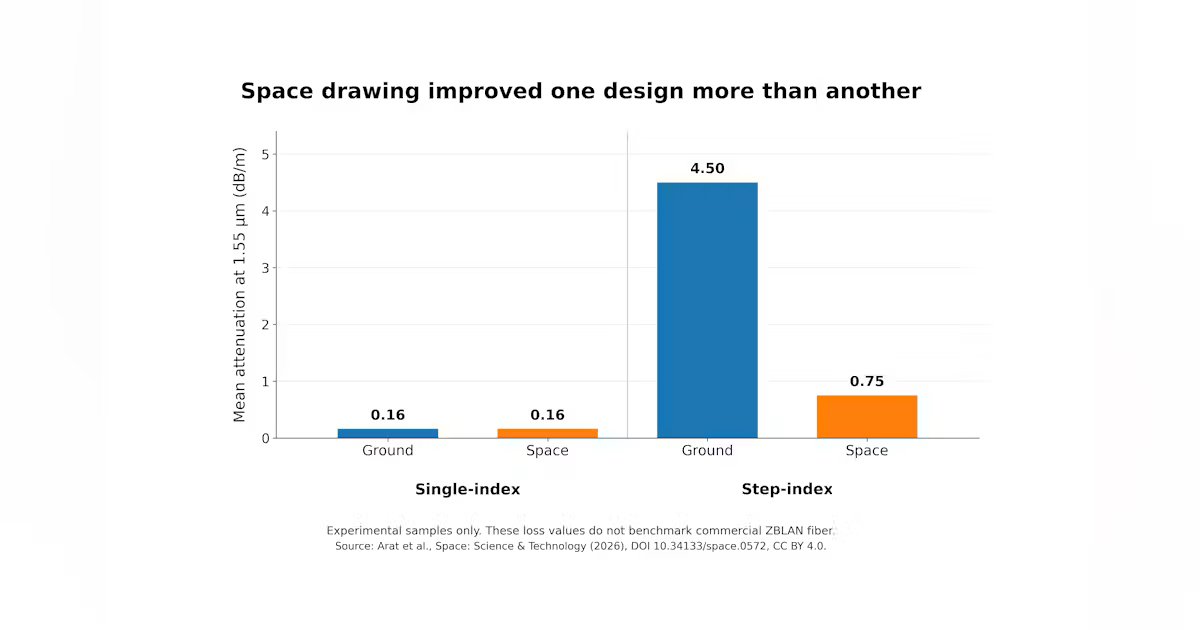
A 2026 study reported mean attenuation at 1.55 µm of 0.75 dB/m for space-drawn step-index ZBLAN, compared with 4.50 dB/m for the corresponding ground-drawn samples. The step-index fiber has a distinct core and cladding. In the same study, single-index fiber averaged about 0.16 dB/m in both environments. Microgravity improved the tested step-index design, while the single-index result showed how strongly composition and fiber design influence the outcome.3
These measured values provide a useful basis for the next generation of experiments. The comparison in Figure 1 also makes clear why fiber type, wavelength, and test method must accompany every reported loss figure. A result in decibels per meter must be distinguished from one in decibels per kilometer, and the measurement wavelength must match the intended product.
The most useful question for a laser or sensing customer is straightforward: Will the finished fiber deliver lower loss, the required beam quality, and reliable handling at the wavelength and length specified for the application?
Start with the application
A short fiber for a mid-IR laser, a spectroscopic instrument, and a long optical link will all have different requirements. The qualification plan should begin with a defined use case and an agreed acceptance limit for attenuation, geometry, bend performance, and continuous length.
Measurements at 1.55 µm are informative, but many potential ZBLAN applications operate farther into the IR. A qualification program should measure attenuation across the proposed operating band, including wavelengths between 2 and 5 µm when relevant. The results should state launch conditions, specimen length, fiber structure, measurement uncertainty, and the treatment of connector or coupling losses.
IEC 60793-1-40:2024 describes cut-back, insertion-loss, and backscattering methods for attenuation measurement. In a cut-back test, the laboratory compares transmitted optical power before and after shortening the same specimen while maintaining the optical launch conditions. This provides a useful reference for a repeatable test method, with any adaptations for fluoride glass and longer wavelengths properly recorded.4
Compare matched samples
An orbital sample should be compared with a terrestrial sample made from closely matched input material. Feedstock purity, preform geometry, core and cladding composition, thermal history, draw speed, atmosphere, coating, and storage conditions all affect the result. Record differences between the ground and flight equipment rather than attributing every measured change to gravity.
The proposed protocol in Figure 2 follows the same material through two processing environments and a common set of independent tests. A matched ground draw helps isolate the effect of microgravity. A separate, commercially available reference fiber shows the performance that customers can buy today. Together, these comparisons establish the size and practical relevance of an improvement.
Material analysis should explain the optical measurement. Microscopy, spectroscopy, inspection for crystal inclusions, and checks of diameter and concentricity can identify the dominant loss mechanisms. The 2026 study linked much of the step-index improvement to reduced crystal-related scattering while identifying impurities and other defects that remained relevant in both environments.3