
Nitinol laser welding parameters
Welding or joining nitinol is often necessary when manufacturing medical devices, surgical tools, or components for other industries with complex shapes or multiple parts—such as tubes, wires, and sheets, that can’t be produced from a single piece of material—to allow precise control of the final device geometry. Among the available joining methods, laser welding is one of the most widely used for NiTi alloys because it produces narrow and high-quality welds with low heat input, limited heat-affected zone (HAZ), fast process, and excellent process repeatability.
But laser welding NiTi alloys can present significant technical and metallurgical challenges if the process parameters are not set correctly, because nitinol is highly sensitive to processing conditions and even small variations in manufacturing or finishing can significantly alter its functional properties. Excessive heat generated during welding can cause unwanted phase transformations and microstructural changes, which can negatively affect the material’s transformation temperature, shape memory effect, superelasticity, and fatigue life. Variations in laser welding parameters can also lead to inconsistencies in weld quality and mechanical performance, so parameters such as pulse duration, pulse shape, spot size, focus position, laser power, and energy, as well as the type of shielding gas and the method used to deliver it to the weld area, plays an important role in controlling the amount and distribution of heat supplied to the material and determining the final weld quality.
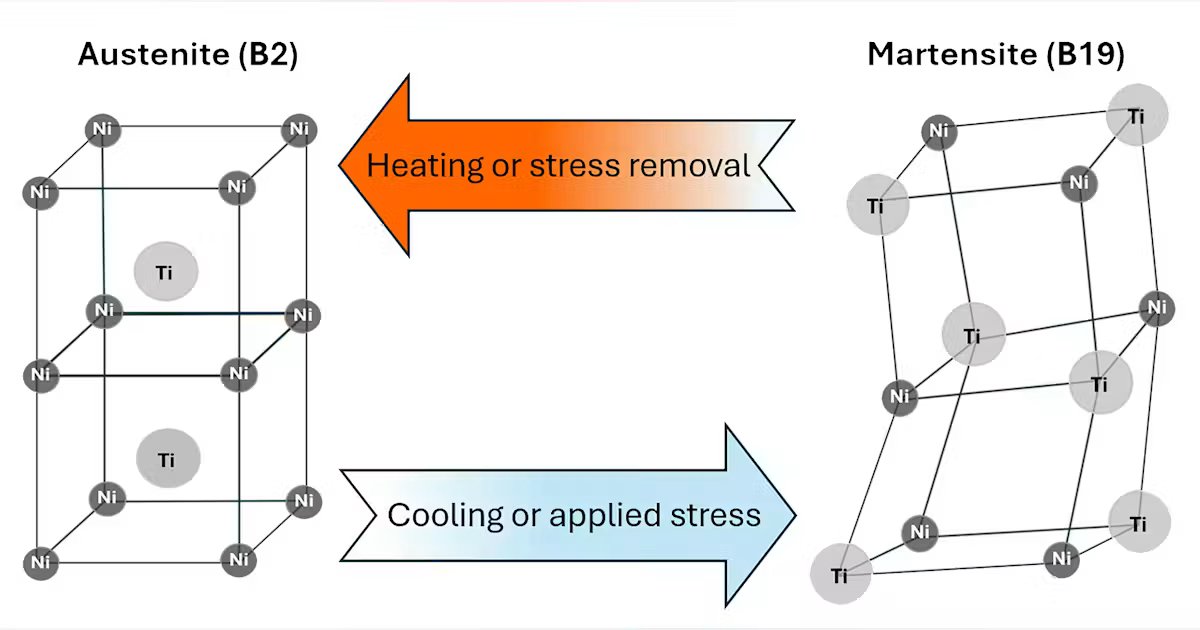
Using a relatively small laser spot size, an appropriate pulse shape, and a short pulse duration allows the laser energy to be concentrated within a small area for a short period of time, which controls how long the material is exposed to laser heat. This limits heat transfer into the surrounding nitinol and reduces the size of the HAZ, which can be beneficial for NiTi alloys because it helps preserve the high-temperature B2 phase at room temperature and limits decomposition into equilibrium phases. A large HAZ can negatively affect nitinol by changing its microstructure and transformation behavior, which may reduce its shape memory, superelasticity, and fatigue life.
Proper shielding gas delivery helps protect the molten weld pool and the surrounding HAZ from atmospheric contamination and oxidation during the welding process, while also improving the surface finish and cosmetic appearance of the weld. This is especially important for medical components or surgical tools, where excessive oxidation can affect the surface quality, corrosion resistance, and biocompatibility of the finished device. Poor surface conditions can also increase the risk of nickel-ion release, which is an important consideration for nitinol devices that come into contact with human tissue or blood.
One of the most common shielding methods used in industry is side-tube gas delivery. But this method may not provide sufficient or uniform gas coverage over the entire welding zone. As shown in Figure 3, the coaxial shielding gas delivery system that delivers the shielding gas around the laser beam can provide several advantages compared to conventional side-tube delivery. These advantages include maintaining more uniform gas coverage during welding, improving the surface finish, preventing spatter and smoke from reaching the optics, reducing gas consumption, and providing better protection of the weld area.